
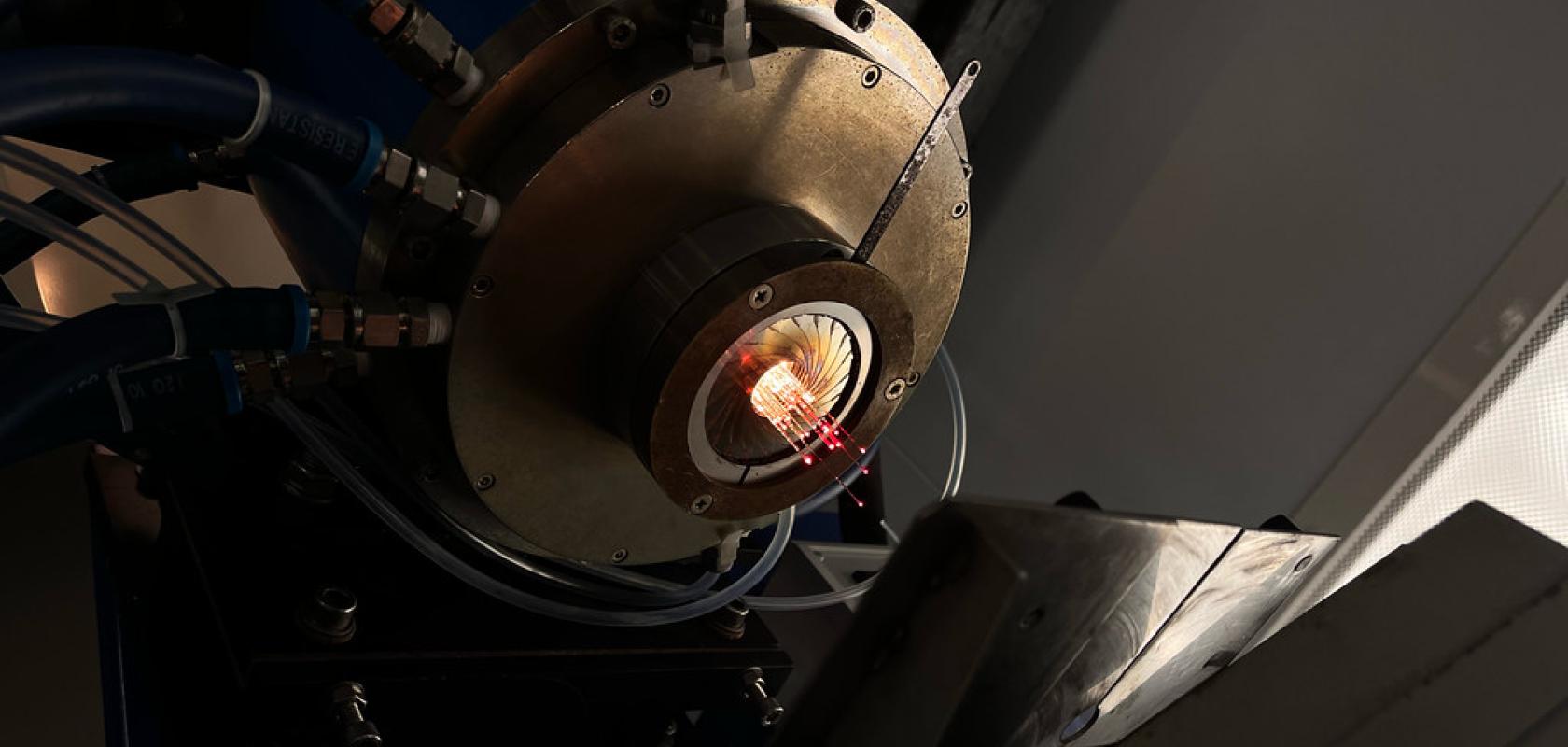
Researchers at the University of Bath, working with the University of Cambridge and international partners, have developed a twisted multicore optical fibre that creates protected pathways for light, allowing signals to flow around manufacturing defects rather than scattering from them.
The fibre-based photonic topological insulator maintains signal integrity even through bends, twists or damage, with potential applications in chip-to-chip optical interconnects, high-bandwidth communications, precision sensing and quantum technologies where uninterrupted light flow is essential.
The study, published in Nature Photonics, demonstrates what the researchers describe as the first optical fibre with two-dimensional topologically protected light guidance.
Twist-induced topological states overcome coupling limitations
Conventional telecommunications fibre guides light along a single core, allowing bidirectional propagation. Imperfections in the glass core can scatter light, either leaking it out of the fibre or reflecting it backwards, degrading or destroying the signal.
Multicore fibres can in principle create additional channels for carrying more data, but light tends to couple between neighbouring cores, mixing channels, introducing noise and limiting reliable information capacity.
The twisted fibre design addresses both problems. Multiple cores combined with a built-in twist create protected states of light that naturally follow the twist and avoid coupling into other cores. When light encounters a defect, it flows around it rather than scattering, potentially delivering far more robust signal transmission.
Compatible with existing fabrication infrastructure
The twist is introduced during normal manufacturing steps already used by fibre fabricators, requiring no special processing. The resulting fibre shares many characteristics with standard optical fibre: it can be produced in extended lengths, unlike existing topological insulator materials typically limited to small pieces of solid material; remains flexible; and transmits light with minimal loss.
The technique is fully compatible with existing fibre production methods while adding resilience to defects.
Fabrication and testing
Following extensive design and simulation work, the topological fibre was fabricated in the Centre for Photonics at the University of Bath and tested in the university's optics laboratories.
Dr Peter Mosley, study co-author from the Department of Physics at Bath, said the controlled twist induced topological behaviour that allowed light to flow around defects rather than scatter from them: "It's a clean, scalable way to build robustness into photonic interconnects. This is the first demonstration of an optical fibre with two-dimensional topologically protected light guidance. Even though we used only short lengths of fibre for this demonstration, our work shows a path towards protecting signals in mass-produced optical fibres that could be used in large data centre networks."
Multicore fibres are also finding potential use cases in long-haul subsea networks.
Dr Anton Souslov, associate professor at the Cavendish Laboratory at the University of Cambridge and study co-author, said topological states of light had many potential uses in communications and quantum technologies: "It is exciting to see them realised in such a scalable and ready-to-use platform as optical fibre."
The researchers used standard telecom-grade materials to create the multicore fibre structure before introducing the twist during fabrication.