
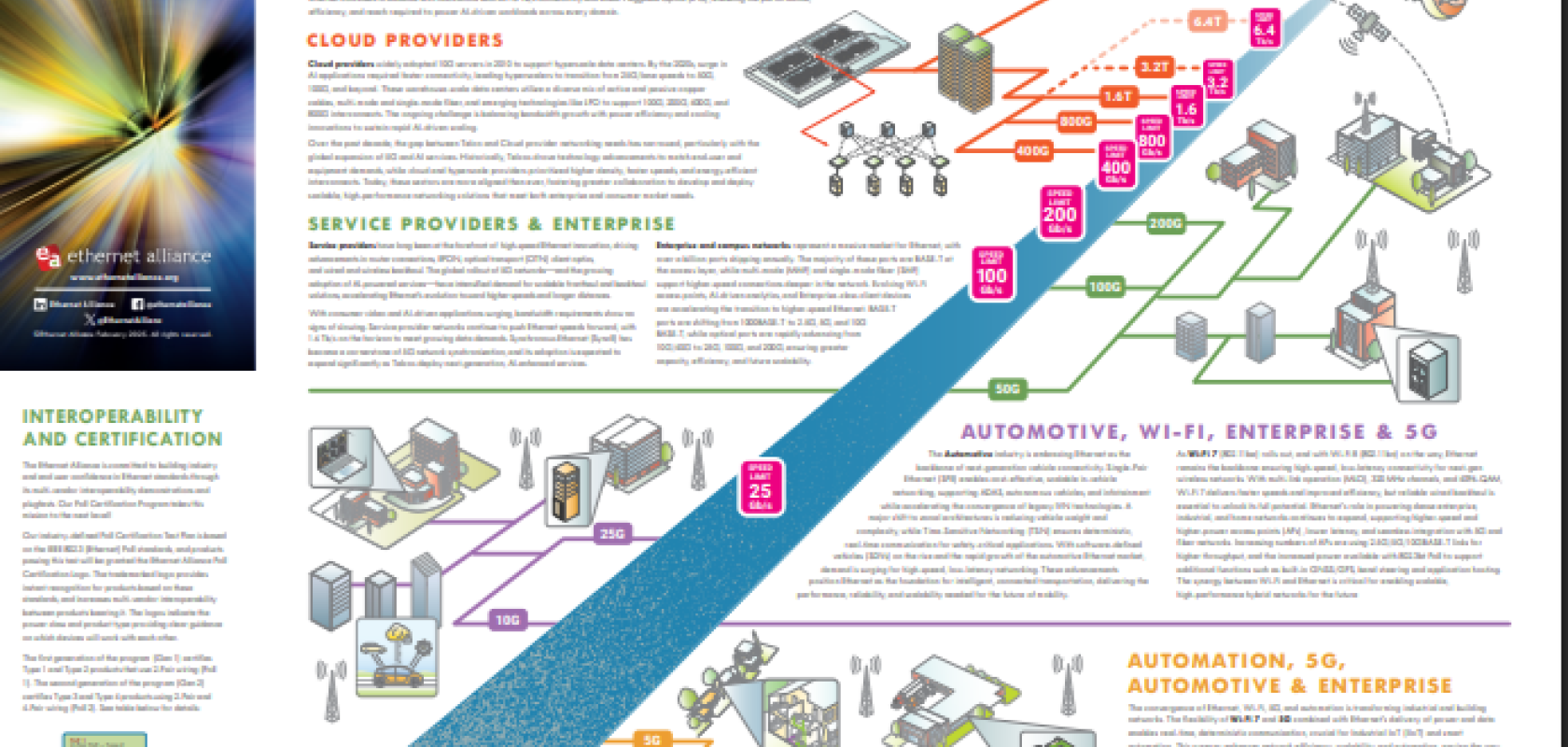
The Ethernet Alliance has released its 2026 Ethernet Roadmap, outlining the key multi-terabit technology developments and trends expected to shape high-performance, AI-driven networking over the coming years.
Initially presented during TEF 2025: Ethernet for AI, the roadmap highlights critical advances including 1.6 terabit-per-second (Tbps) interfaces, Linear Pluggable Optics (LPO), enhanced copper and fibre options, and energy-efficient designs to support explosive growth across AI, cloud services, automotive, manufacturing, and edge computing applications.
Deepening convergence across sectors
The roadmap identifies deepening convergence as hyperscalers adopt 100G to 800G interconnects, telecommunications operators deploy advanced DWDM and coherent optical transport for 5G and AI infrastructure, and enterprises transition to 2.5G/5G/10G BASE-T with higher-speed optical uplinks.
"A half-century down the road, Ethernet has reached its next turning point," said Peter Jones, chair of the Ethernet Alliance. "The 2026 Ethernet Roadmap shows how Ethernet is staying ahead of network changes, delivering the correct mix of performance, power, and flexibility as AI becomes central to what we do every day."
Automotive and industrial networking evolution
The document outlines increasing adoption of automotive Ethernet in software-defined vehicles alongside the arrival of Wi-Fi 7 and 8 standards. Industrial networks are evolving through Time-Sensitive Networking (TSN), BASE-T1 PHYs, and converged 5G/Wi-Fi/Ethernet systems enabling real-time automation.
The Ethernet Alliance positions the roadmap as a guide to how the standard is adapting to meet AI's stringent bandwidth and latency requirements whilst maintaining flexibility across diverse deployment scenarios.
Power efficiency focus on LPO and optics performance
With global electricity consumption rising, the 2026 roadmap emphasizes the industry's focus on improving bandwidth per watt. This involves advancing optics performance and developing enhanced cooling and power management solutions. The consortium identified these elements as critical to sustainable AI growth and Ethernet's continued expansion.
LPO technology features prominently, as operators seek to reduce power consumption and simplify transceiver designs for high-speed data centre applications. The LPO approach eliminates the power-hungry Digital Signal Processor (DSP) within optical modules, transferring these complex signal conditioning functions to the switch ASIC.
The Ethernet Alliance's roadmap serves as a reference document for network equipment manufacturers, chip vendors, optical component suppliers, and network operators planning infrastructure investments aligned with emerging application requirements.