
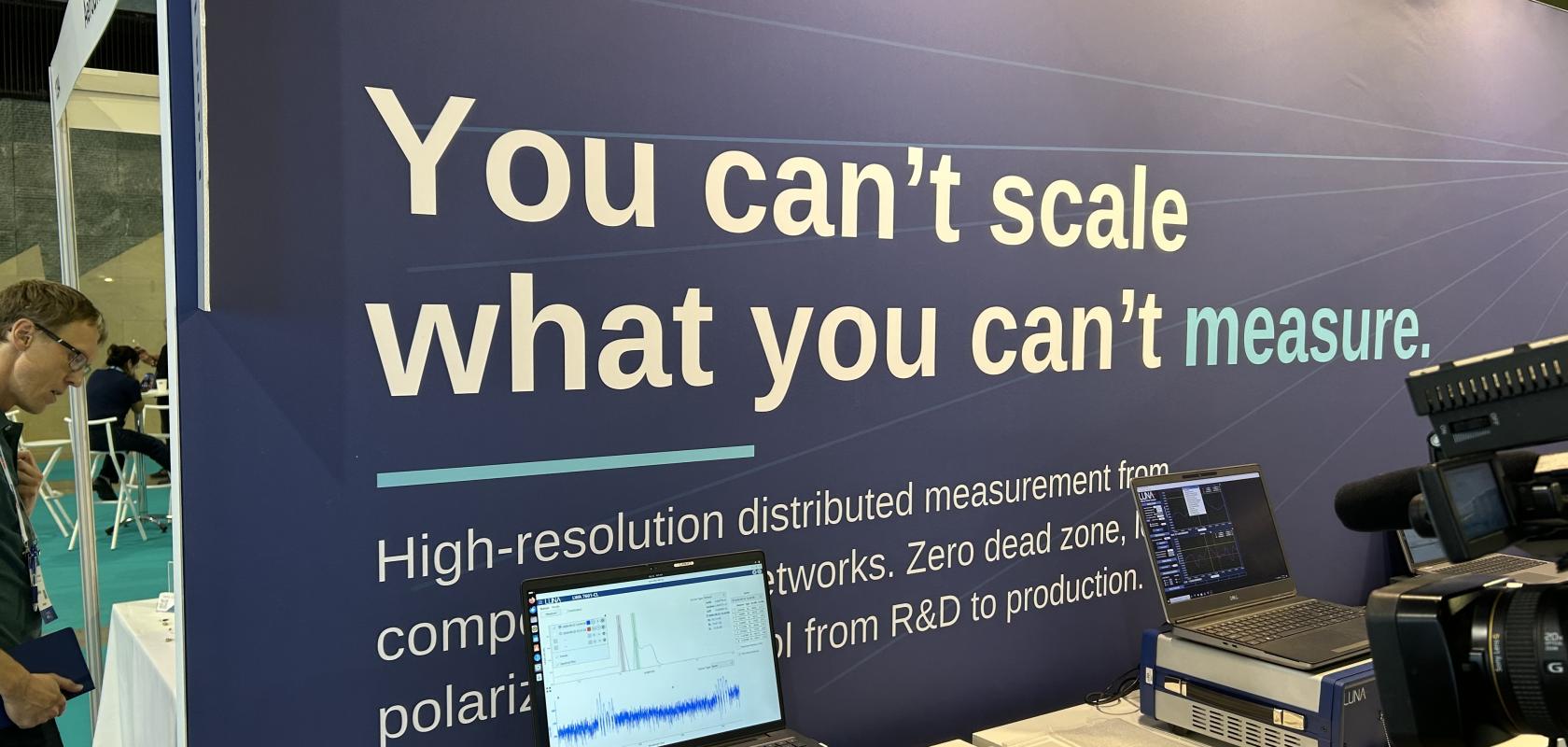
The theme for Luna Innovations this year is ‘you can’t scale what you can’t measure’. The company is an established supplier of advanced optical test and measurement solutions, with a particular expertise in distributed measurement based on OFDR (Optical Frequency Domain Reflectrometry) technology.
Wajih Daab, Senior Director of Product Management, says: “With the expansion in AI, there is a growing need for co-packaged optics, pluggable transceivers, speciality connectors and optical switches. All of these required some sort of distributed measurement. Everything is becoming smaller and more dense, but in order to scale, you have to measure. In order to measure, you have to see through all the way – and that’s what we do.”
Those measurements include all the optical parameters one might expect, such as insertion loss, return loss, polarisation dependent loss, group delay, chromatic dispersion and polarisation mode dispersion.
“Often, users will have multiple components in a series,” continues Daab. “We have the capability to see and characterise each component individually.”
Luna has been a long-term supplier to R&D teams, helping customers reduce the number of design iterations before going into production. “As the complexity of these devices has increased with fibre-to-chip coupling and many ports on a chip,” explains Daab, “we evolved our products to be able to achieve distributed measurement at speed.”
Luna’s testing solutions are used by leading manufacturers of optical circuit switches, as they strive to solve the power consumption issue caused by increased numbers of interconnects. “Every electrical switch hop means an optical-to-electrical-to-optical conversion, and each one burns power and adds latency," says Daab. “Optical circuit switching removes those conversions, which is why hyperscalers are adopting it in GPU fabrics.”
Luna used ECOC 2026 to highlight its distributed measurement product lines, including the LWA Lightwave Analyzer. “We are showing two newer models: one covering the C/L bands and one the O band,” says Daab.
Vanessa Reding, Global Marketing, adds: “As well as the band coverage that these new products offer, it’s also the speed at which we can measure. We have that historical expertise in the R&D community, but we’re now transferring that ability to the production side. We’re responding to market demand by using our technical background to deliver the same spec – or better – at speed.”
Daab explains that improvements to the LWA product line weren’t just about speed. “We improved optical performance,” he says. “We improved communication – for example, faster data transfer, a remote API/SCPI interface – so that it can be used with probe stations and other instruments a lot faster. We increased the accuracy and resolution of the measurements, which means we resolve features separated by as little as 16μm.”
Reding goes on to outline the key benefits of measurement at scale. “From R&D design, through to production, a pass/fail result isn’t enough. Users need to know where the device fault is,” she says. “You don’t want these things failing once they’re out and deployed. When a failed unit comes back, our platforms can locate the root cause quickly and efficiently.”
Reding concludes: “We are experts at understanding light and turning measurements from light into insight that companies can use, both on the technical side and the business side. We are therefore constantly developing new product iterations in response to market changes.”
For Daab, key differentiating factors include the acquisition rates of its OFDR platform. “Our LWA is an order of magnitude faster than any other OFDR system on the market,” he claims. “We can also test fibre networks up to a range of 2km. Our measurement capabilities are second to none – we can capture Jones-matrix measurements, including amplitude phase polarisation response all together in one scan, while competitors can only do amplitude response.
“Our dynamic range is significantly higher too. Most of the market is capped at around 80dB for return or loss dynamic range. Luna’s reaches 90dB, potentially 95dB. That 10dB improvement is a big deal, since you can detect a very bright reflection and a very weak reflection at the same time, even though they are 90dB apart.”
With its next generation range of products on display at this year’s ECOC, Luna Innovations is cementing its position as a leader in measurement solutions for the optical communications industry, particularly as it addresses the demanding needs of AI data centres.