
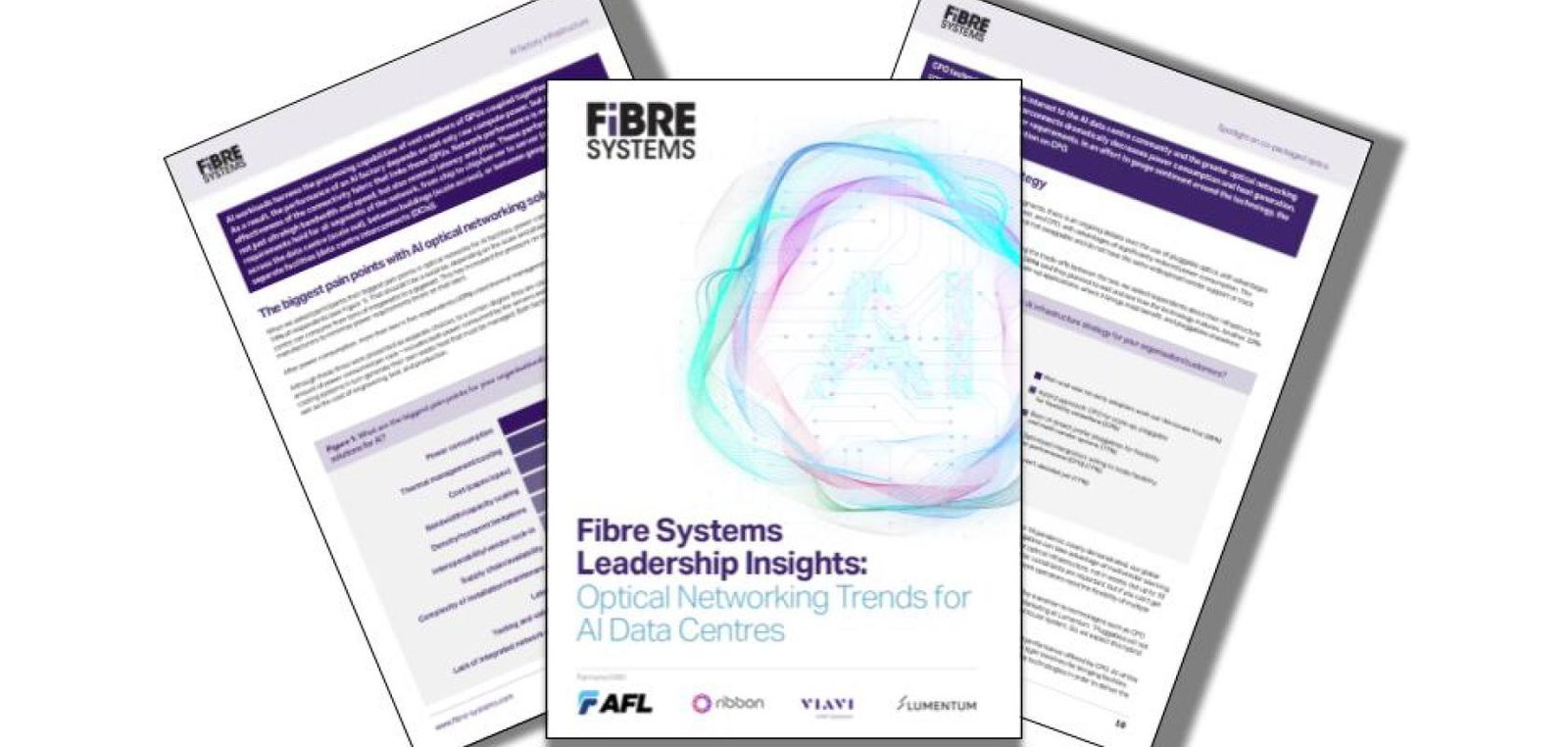
AI infrastructure is changing data centre networking faster than most roadmaps can keep up. Copper has given way to optics, and power consumption has become the defining constraint. As GPU clusters grow from thousands to hundreds of thousands of processors, the choice of optical technology now shapes performance, efficiency and scalability. Yet there is still no clear front runner. Facilities range from hyperscale AI factories to multitenant AI data centres, and each has different needs.
To find out how the sector is responding, Fibre Systems surveyed qualified experts in July and August 2026. Respondents included technology developers, system integrators, data centre operators and executives, with more than a third based in the UK and Europe and another 29% in North America. Their answers show where investment is going, where the doubts lie, and what would speed up adoption.
What you’ll learn from reading "Optical networking trends for AI data centres"?
- Which pain points matter most, from power consumption and thermal management to cost and bandwidth scaling
- How organisations are approaching emerging technologies, including optical circuit switching, hollow-core fibre, linear pluggable optics, near-packaged optics, co-packaged optics and multicore fibre
- How transceiver usage is expected to move from 400G and 800G towards 1.6T across scale-up, scale-out, scale-across and DCI networks
- Why CPO adoption depends on standardisation, field reliability and multiple vendor sources
- When respondents expect CPO to be ready for deployment, and what would persuade them to adopt it
Who should read "Optical networking trends for AI data centres"?
Network architects and optical engineers planning AI infrastructure will find practical benchmarks for comparing their strategies with peers. Data centre operators and product teams weighing pluggables against CPO will find the trade-offs laid out clearly. The findings suggest there is no single answer, so the report is designed to help you test your own assumptions.
Why do I need to download "Optical networking trends for AI data centres"?
AI facilities behave less like a class of standard data centres and more like a collection of one-off builds. Choosing the wrong optical technology can lock in power, cost and deployment risks for years. This report shows where the industry stands today, so you can plan with a clearer view of what peers are testing, deploying and waiting on.
What will I learn about optical networking for AI?
By downloading this Leadership Insights report, you will discover:
- Pain point priorities: Why power consumption came first for 74% of respondents, and how thermal management and cost follow closely behind.
- Technology uptake: How testing and deployment of emerging fibre and optical technologies compares across the industry, and where no single solution has yet pulled ahead.
- Transceiver roadmaps: How expectations for 400G, 800G and 1.6T transceivers change across network segments over the next five years.
- The CPO debate: Why reliability, standards and multiple sources matter more than performance for many buyers, and when respondents expect CPO to reach mainstream use.
Partners
Fibre Systems thanks AFL, Lumentum, Ribbon Communications, and VIAVI Solutions.