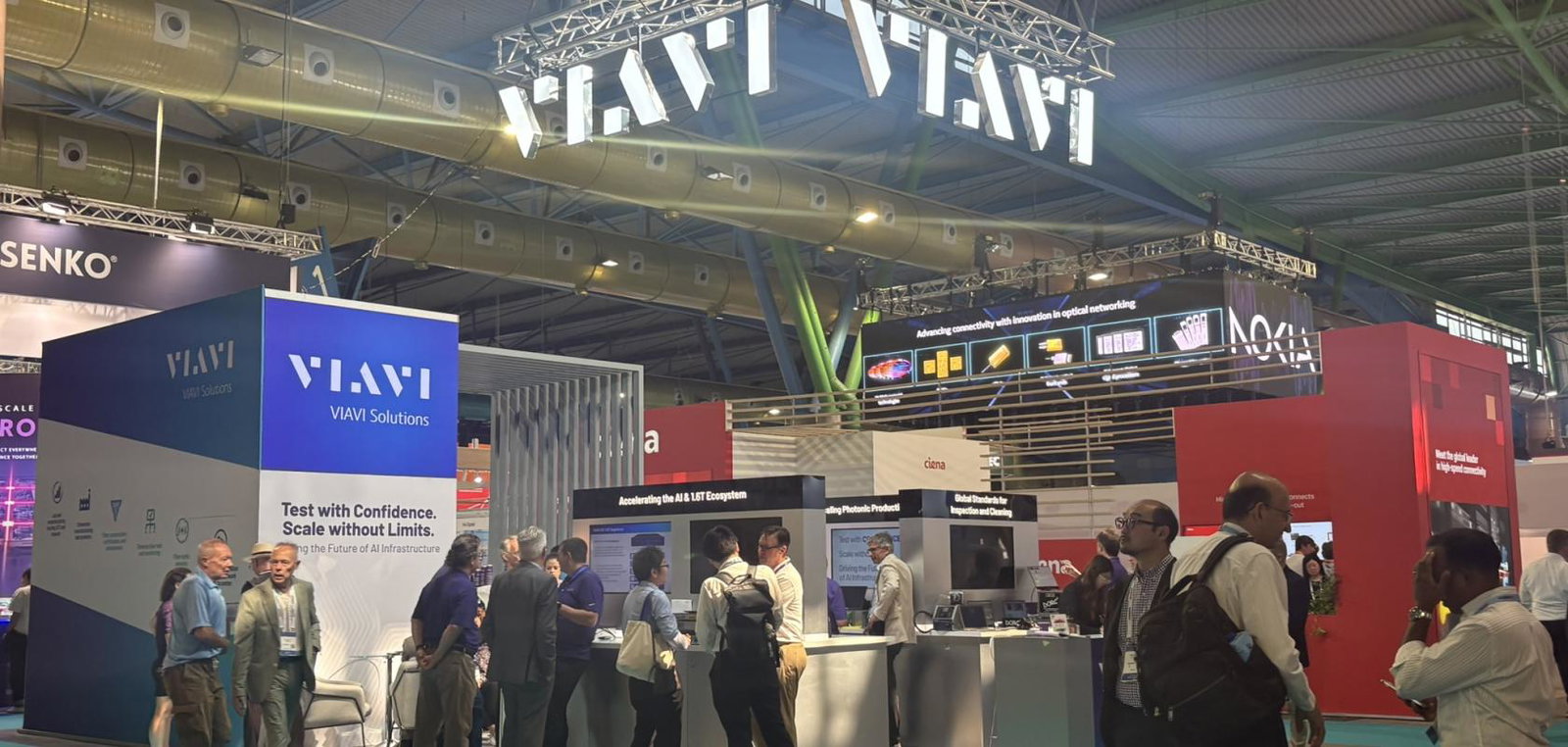
At ECOC 2026 in Málaga, VIAVI Solutions showcased its end-to-end data centre testing portfolio supporting the scale-up, scale-out, and scale-across architectures driving AI and high-performance computing (HPC) networks. As infrastructure advances toward 1.6T Ethernet and beyond, VIAVI's strategy is to provide test and validation capabilities throughout the entire network lifecycle, from design and manufacturing to deployment and ongoing monitoring. By combining its deep expertise in physical-layer testing with recently acquired interferometry and validation technologies, the company is expanding its ability to address the increasingly complex requirements of AI network infrastructure.
1.6T validation and an industry first in heat sink testing
On the lab side of the booth, VIAVI demonstrated the ONE LabPro ONE-1600 IHS, the first fully integrated test solution for pluggable 1.6T transceivers. The platform now supports both integrated heat sink (IHS) and riding heat sink (RHS) optics within a single module. According to Ramnik Johar, VP of Business Development at VIAVI, the ONE-1600 is the first test solution in the industry to support both form factors in a single integrated platform, maximising flexibility.
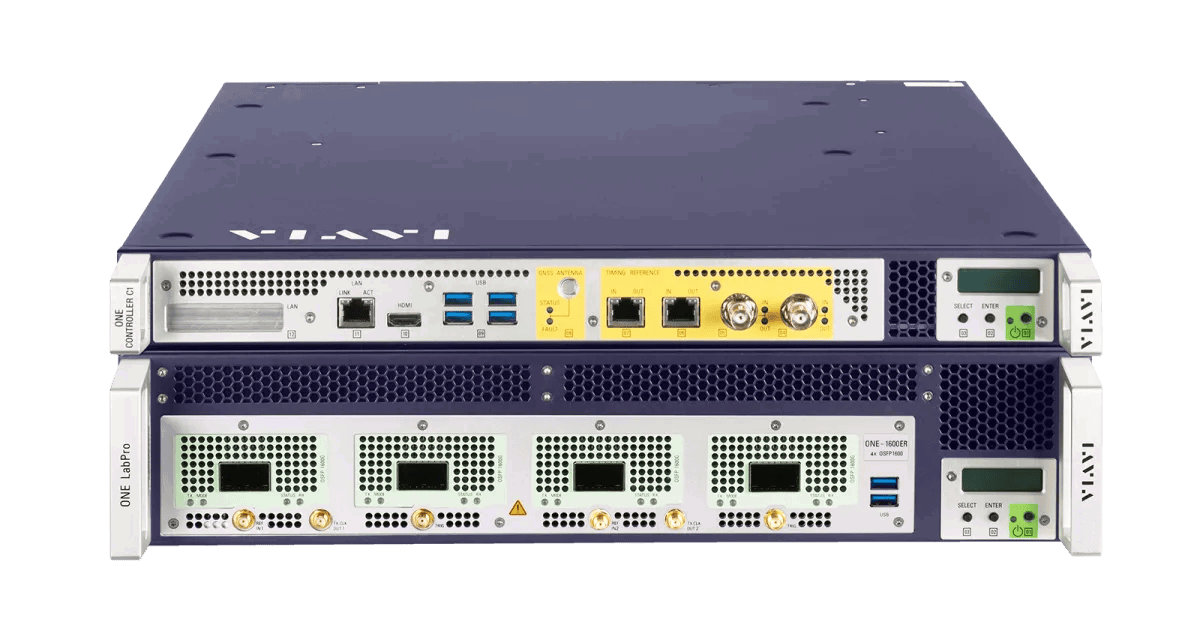
The distinction between the two form factors is being driven by hyperscale requirements. Most of today’s optical modules use integrated heat sinks (IHS) with fin-like structures to dissipate heat, while emerging 1.6T designs are increasingly adopting riding heat sinks (RHS), which feature a flat-top surface that enables airflow through a dedicated cooling assembly.
Johar said the increasing power demands of next-generation optics are creating new thermal management challenges, with 1.6T transceivers drawing 32 to 36 watts, compared with roughly 15 watts for earlier generations. “VIAVI developed its 1.6T testing capabilities by working closely with major hyperscalers and working backwards from their evolving needs. The entire AI ecosystem is really driven by hyperscalers,” he said.
The platform is already shipping, with the ONE LabPro 800G generation available in the market for several years. VIAVI has also introduced the ONE-1600 ERP module, aimed at network equipment manufacturers and production environments, offering a streamlined set of core validation capabilities at a lower price.
Emulating the GPUs for AI fabric validation
The High-speed Ethernet side of the portfolio gets a major boost from VIAVI’s acquisition of Spirent’s test assets in October 2025. The deal brought Spirent’s TestCenter platform into the VIAVI portfolio, including the TestCenter D2 1.6T appliance, which was showcased at ECOC. Designed to validate Layer 2 and Layer 3 performance under AI-driven traffic conditions, the platform is positioned as the industry's first Ultra Ethernet transport validation solution, helping network developers test and optimise infrastructure for emerging AI workloads.
Johar described TestCenter as the missing piece in VIAVI’s lab portfolio. "It’s a perfect marriage," he said, noting that VIAVI’s existing ONE LabPro solution addresses Layers 0 to 2, while TestCenter extends validation into Layer 3 and higher.
Rather than requiring tens of thousands of physical GPUs to validate AI network fabrics, the platform enables users to emulate AI workloads in using configured training and inference models. "It’s literally replicating AI data centre workflows in a lab, as opposed to using real GPUs" he said.
Johar said the D2 platform can emulate up to 128 GPUs per port and be easily scaled through cascading, this reduces the amount of equipment needed for testing and validation greatly improving cost, power and cooling efficiency. The platform is designed to identify overall capacities, interconnect bottlenecks, latency hotspots, and fault-tolerance issues that can limit GPU utilization and overall, AI data centre performance.
Manufacturing test: where two worlds collide
In manufacturing, VIAVI expanded its MAP-300 platform (pictured below) with new modules for co-packaged optics (CPO) and silicon photonics modules: including a Remote Head Polarity Mapper, a high-density variable optical attenuator (VOA), and high-density optical power meters. The platform also supports quantum key distribution (QKD) and hybrid network evaluation.
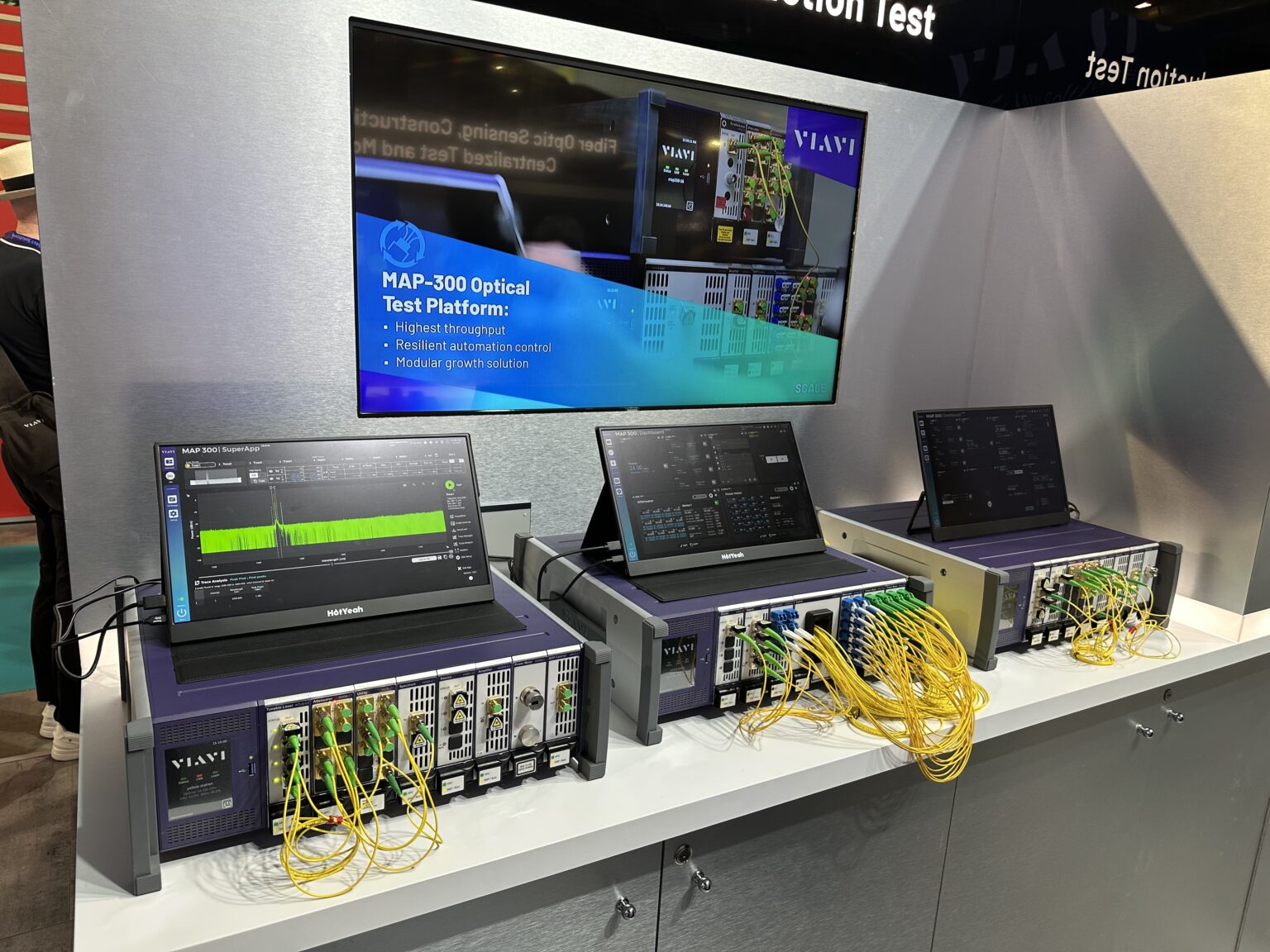
The MAP-300 optical test platform, displayed at ECOC 2026 (Credit: VIAVI)
The emergence of co-packaged optics is changing how tests are done, according to Matt Adams, Product Director at VIAVI. He described CPO as "the first volume collision between two somewhat, if not very, different perspectives on test: semiconductor-focused test now colliding with optical test."
Each side has had to adapt. Optical test specialists have had to learn what it means to work in a semiconductor ecosystem, while silicon test teams have had to accept that some limits are physics. "As much as they might like photons to behave like electrons," Adams said, optical testing cannot always behave like silicon testing.
The growing complexity of co-packaged devices is also shifting testing earlier in the manufacturing process. "A lot of what we associated with end-of-line tests is moving deeper and earlier into the process, because it has to, "Adams said. The tension, he added, is "between what tests we need to do and what tests we can afford to do."
Silicon customers also bring a different tempo. Adams described them as extremely aggressive, with room for only one or two vendors in any market, so the move from decision to ramp is quick. They also put a higher premium on density. "It’s not two anymore, it’s how do we increase the density by a factor of eight, 16," he said, because silicon fab floor space is far more expensive than contract manufacturing floor space.
Reliability matters just as much, since equipment is expected to run around the clock without human intervention. "You can make the best measurement in the world, but if the equipment crashes every six hours, you’re nowhere," he said.
Connector geometry, from a newly acquired specialist
ECOC was also the first public showing of the DORC product line, recently acquired by VIAVI. DORC, founded in 1992, builds interferometers for fibre connectors, including the ZX-1 series for single and multifibre connectors. VIAVI already offers handheld, benchtop, and lab-grade inspection scopes, which show whether an end face is clean. Interferometry shows its shape, producing a 3D map of curvature, position, and angle for every ferrule in a connector such as a 12-fibre MPO.
Connector volumes explain why this matters. By some estimates, Adams said, "hundreds of millions of optical connections" will need to be added to existing volumes to bring CPO to market. Each connector will go through "half a dozen or more inspections and cleanings" on its way from manufacture to the co-packaged device, the appliance, and the rack. Newcomers from the electronics and white-box Ethernet world, he said, are struggling to believe that connector management is as complicated as it is, so VIAVI finds itself coaching customers on it.
On the stand was a prototype, designed to measure connectors while they are still in the polishing plate which accelerates the process. Faulty connectors can then be scrapped before further labour goes in, and before handling adds scratches or dirt. The first version handles single-fibre connectors, with multifibre types planned.
Field testing for denser fibre
On the field side, Gregory Lietaert, Product Line Manager, said the company’s deployment and monitoring equipment is "highly driven by what’s happening in the world, like AI, more data centres, higher fibre densification, new fibre types."
One of those new types is hollow core fibre. VIAVI showed OTDRs and test sets for it on the T-BERD/MTS-4000 and OneAdvisor 800 platforms, and a VIAVI spokesperson said it has run longer-distance trials with providers. The company offers a characterisation solution that covers both single-mode and hollow core fibre, so one technician can handle either job.
Denser connectors are another challenge. "What’s new for us is the fact that you have more and more fibres bundled in one single connector," Lietaert said, citing MMC and MPO types. VIAVI’s answer is the DCX-700, which automates tier-1 testing of loss, polarity, and length for high-fibre-count networks, with a variant for campus links between buildings. A standard tier-1 test can tell you a link has failed but not where, so an embedded OTDR locates the fault and guides the technician through the next step.
"We try to guide the technician as much as we can so that we can speed up the test," he said. An optical switch lets one unit test many fibres in sequence. The MAP-2800 test head, the first rack-mounted Ethernet tester for centralised and field testing from 10M to 800G, works with the Fusion system to reduce truck rolls.
Monitoring and sensing
As 800G links make each fibre more critical, VIAVI showed monitoring solutions that can scan live fibre, with or without traffic, raising an alarm and locating the fault so the technician can fix it quickly. This also helps operators ensure their fibre infrastructure is ready for service as high-speed connections come online – or, in other cases, as they are handed over to hyperscalers - and remains reliable throughout its lifecycle. Koji Okamoto, Vice President, Fibre Access Solutions, also described a sensing suite that uses the fibre itself as a sensor. Temperature sensing can flag hotspots in a data centre, strain sensing based on Brillouin OTDR shows whether a cable has been stretched after an incident, and acoustic sensing, long used in oil and gas, is drawing growing telecoms interest for subsea and backbone routes, critical links between data centres, and perimeter security.
VIAVI's focus has shifted beyond test hardware to complete workflow solutions. "We no longer sell just boxes," he said. "We sell boxes with test automation, test process automation, and a cloud-based solution." Managers can push jobs to technicians, collect the results, and build dashboards. The emphasis is on helping customers scale deployment and operations more efficiently. "There’s so much fibre to be deployed, so much data centre capacity to be built, that we need more efficient tools”, he said.