
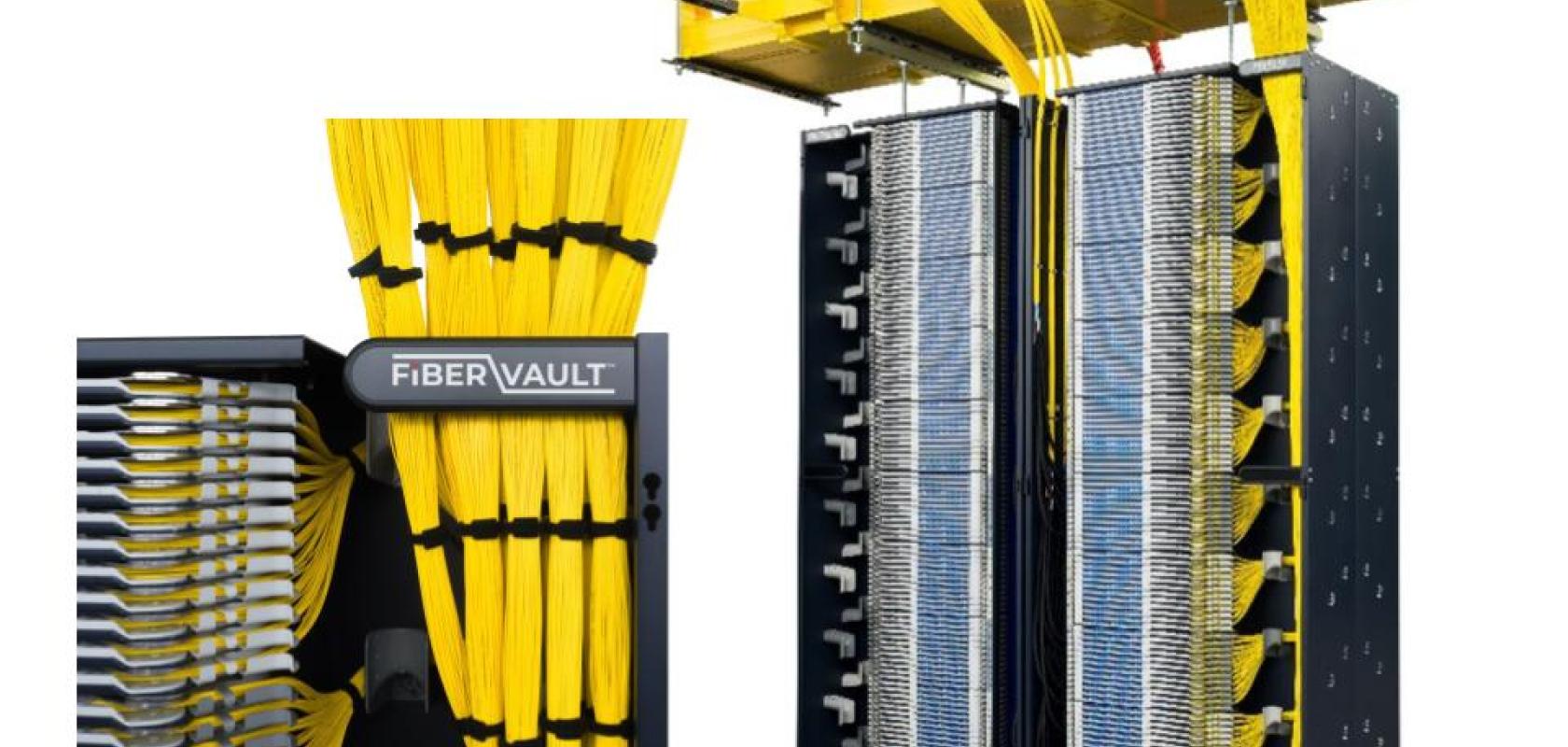
Amphenol Network Solutions has introduced FiberVault, a high-density optical distribution frame (ODF) designed to manage the massive fibre counts required in data centres by artificial intelligence (AI) infrastructure.
Launched at BICSI Winter 2026, the system features a light-guided circuit identification method to replace manual labelling in complex splice-only environments.
The frame supports 5,760 splices per unit, or up to 11,520 in a back-to-back configuration. It is specifically built to assist hyperscale operators as they scale to the dense mesh topologies required by GPU clusters, where traditional connector-based identification often fails to scale.
Visual tracing for splice-heavy environments
A central feature of the FiberVault is its integrated tracer fibre system. This uses a three-fibre jumper configuration where two fibres carry live data while a third tracer fibre routes to a dedicated window on the front of each shelf.
By connecting a visual fault locator (VFL) to one end, a technician can see light appear in the corresponding window on the opposite side. This provides positive circuit confirmation without the risk of interrupting live traffic or relying on error-prone manual logs.
Harley McAllister, senior product manager at Amphenol Network Solutions says: "AI-driven networks are deploying four to five times more fibre than traditional environments. With FiberVault, we are giving operators extreme density and a simple, light-guided way to confirm exactly which circuit they are working on without taking traffic down."
Designed for 1.6T and mesh topologies
The architecture of the FiberVault reflects the shift toward single-fibre splicing in AI factories. Dense GPU clusters require the low loss and high reliability of fusion splices, but they also demand an "any-to-any" mapping capability that can be difficult to manage at scale.
The frame organises connectivity across 120 pivoting shelves. Each shelf contains six trays, limiting the exposure of adjacent circuits during maintenance. This compartmentalisation is essential for maintaining "Day 2" operations in 800G and 1.6T environments where downtime is not an option.
Streamlined deployment and manufacturing
To accelerate site turn-up, the frames are manufactured in North America and ship fully assembled with factory-installed shelves and integrated forklift slots. Universal breakout kits are included to accommodate rollable ribbon cables from any manufacturer, providing a uniform approach to cable management regardless of construction.
Amphenol plans to evolve the platform further to support mass fusion splicing and connectorised "patch-and-splice" options as data centre architectures continue to diversify.