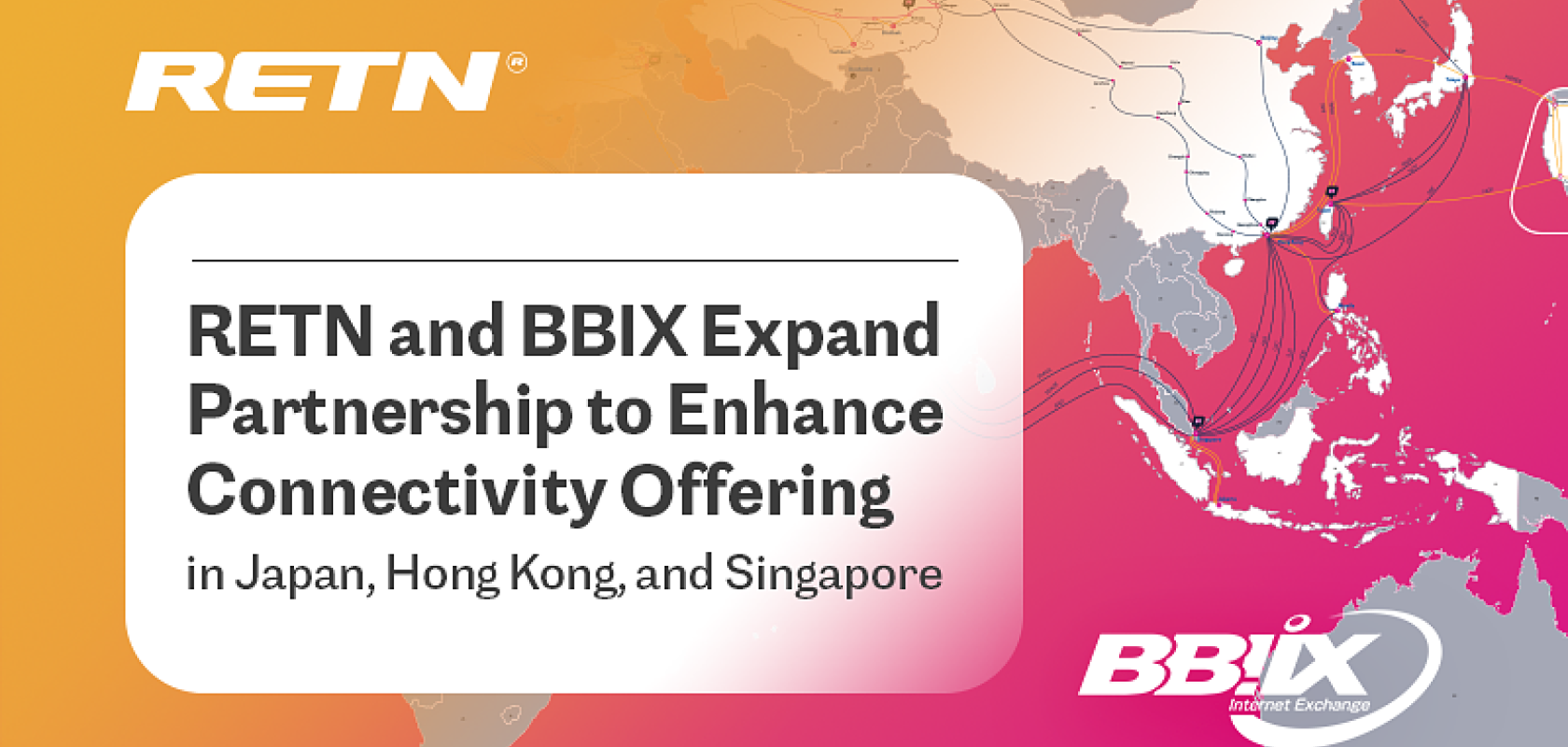
Independent network services provider RETN has expanded its partnership with BBIX, a major internet exchange operator in Asia, to include strategic peering locations in Hong Kong and Singapore. This extends the companies' existing collaboration in Japan.
The expanded partnership allows RETN to offer enhanced peering opportunities and direct traffic exchange with networks across the three markets, addressing demand from global enterprises for low-latency connectivity and infrastructure-light entry into Asia's key digital economies.
Flex IX solution deployed across BBIX locations
As part of the expanded collaboration, RETN is introducing its Flex IX solution across BBIX locations in Tokyo, Hong Kong, and Singapore. The offering combines remote internet Exchange (IX) access and IP transit into a unified multi-service solution. This enables customers to commit bandwidth on a single physical port while optimising resource use between peering and transit needs.
RETN has successfully operated as an official reseller of BBIX services in Japan, with the relationship now broadened to support customers seeking to establish a flexible network presence in the vital Hong Kong and Singapore markets.
"We are delighted to expand our collaboration with BBIX beyond Japan to include Hong Kong and Singapore," said William Manzione, product manager at RETN. "This milestone demonstrates our commitment to broadening our global service portfolio and supporting customers with access to Asia's vibrant markets."
Supporting international business connectivity and growth
Lisa Lu, vice president of global business at BBIX, said the partnership extension builds on successful collaboration in Japan. "Together, we're better equipped to support international businesses seeking reliable and seamless, low-latency connectivity in these dynamic markets," she said. "This expansion underscores our shared commitment to driving growth and innovation across APAC."
The Flex IX solution is designed to provide streamlined bandwidth management and connectivity across the three regional markets, enabling enterprises to access peering ecosystems in each location through a unified service model without deploying dedicated local infrastructure.