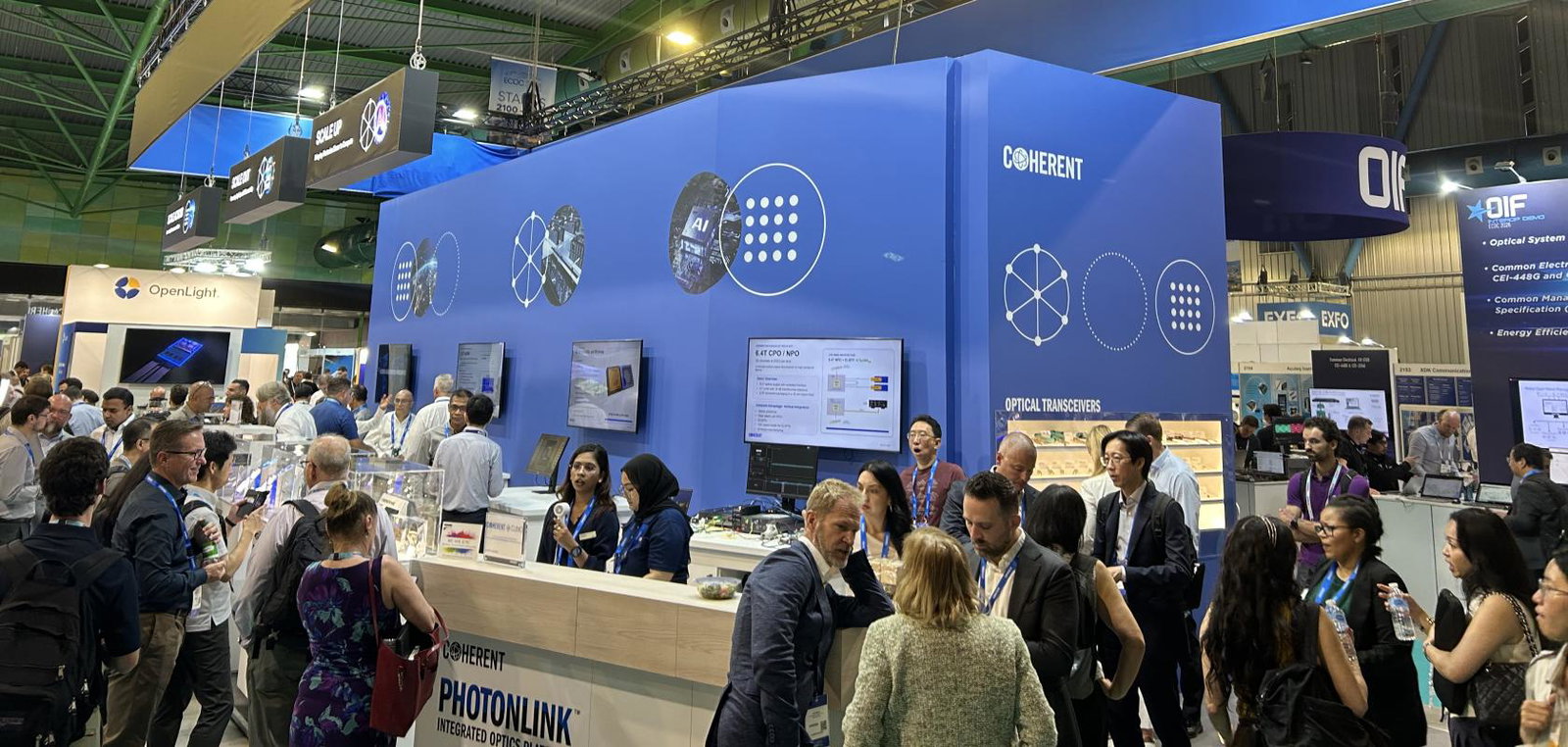
At ECOC this year, Coherent emphasised its commitment to the AI and data centre market with the launch of a new platform, PhotonLink.
Sanjai Parthasarathi, chief marketing officer, says that the company’s focus is very much around scalable connectivity for AI infrastructure.
Solving the AI connectivity challenge: scale across, scale out, and scale up
“This goes across the entire AI infrastructure,” he says, “starting from data centre interconnects, or ‘scale across’, to ‘scale out’, which is connectivity between the racks, to ‘scale up’, which is connectivity within the rack and eventually chip-to-chip interconnects. Essentially, electrical connections are running out of steam. Physics demands the move to optical and we are getting ready for that transition.”
Coherent’s major launch was PhotonLink, its new platform for integrated optics. “We’re bringing together all the technologies within the complete optical signal chain,” explains Parthasarathi, “from generating the photon to shaping the signal, receiving it, detecting it for CPO (co-packaged optics) and NPO (near-packaged optics) architectures for scale out, scale up and eventually chip-to-chip.”
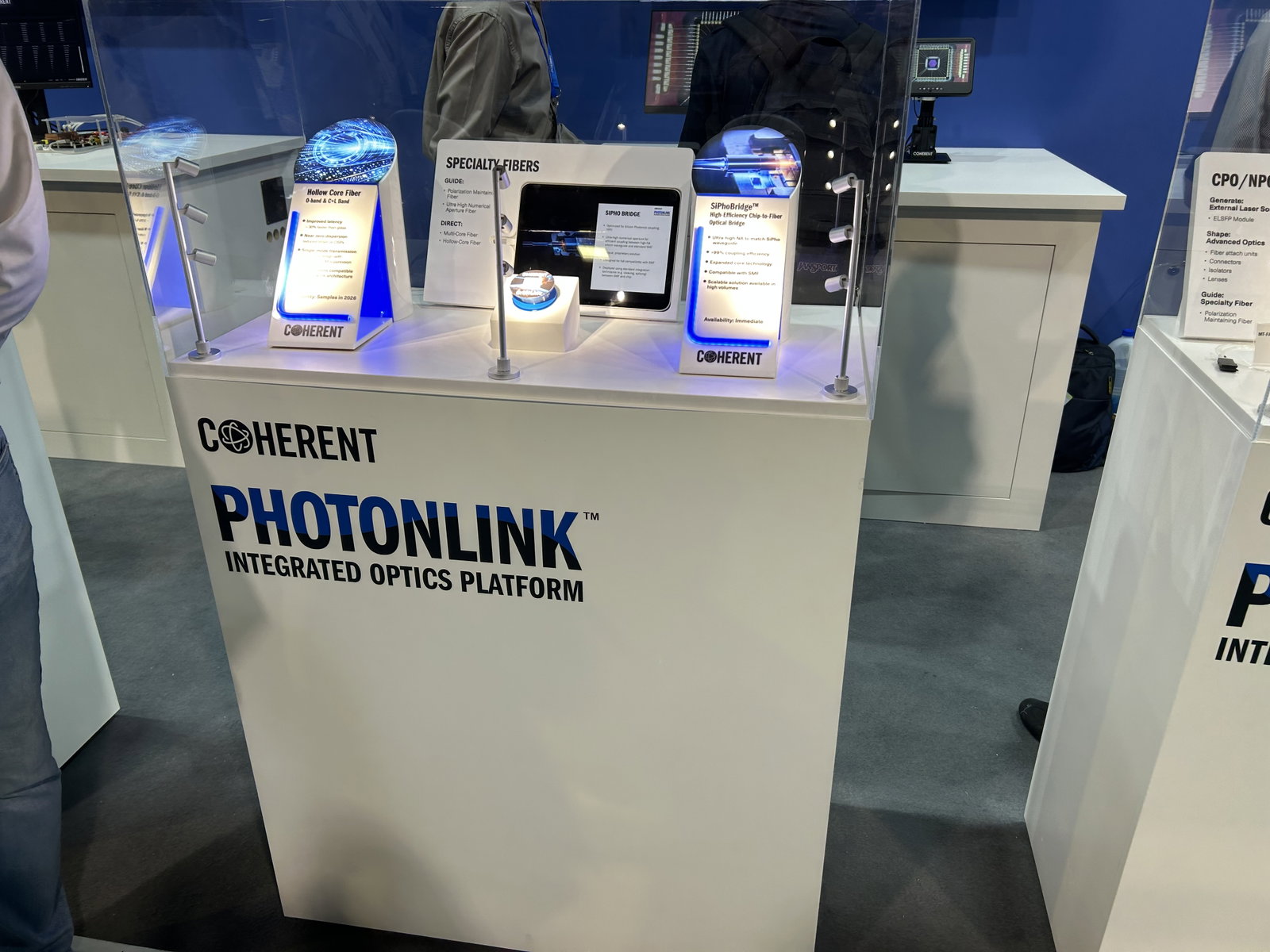
Parthasarathi says the platform is there specifically to address AI connectivity challenges. “There are some very specific requirements for AI in terms of performance, such as high bandwidth, low latency and ultra-high energy efficiency,” he continues. “PhotonLink is optimised for AI connectivity.
“As new customers come into the optical connectivity space, they see the complexity of sourcing components from multiple suppliers and getting them all to work together. PhotonLink addresses exactly this pain point.
“Now, PhotonLink covers CPO, NPO and chip-to-chip interconnects, both at an integrated optics level as well as at component level; we have reference design to optimise how all the different elements work together, for example: VCSEL-based NPO solutions, silicon photonics-based CPO solutions, or indium phosphide-based CPU solutions.”
Partnerships and market scope: from hyperscalers to GPU makers
The potential customer base for PhotonLink spreads from hyperscalers to GPU makers, through to processor and memory makers. “It’s aimed at anyone who’s looking to optically connect a group of processors, or improve connectivity either within a rack or rack-to-rack,” concludes Parthasarathi.
Coherent is already working with Nvidia on CPO and NPO solutions to help with bandwidth efficiency. “It’s always been about how much data we can move, how fast and how cost-effectively we can move it, and what’s the lowest power we can use to achieve it,” he adds.
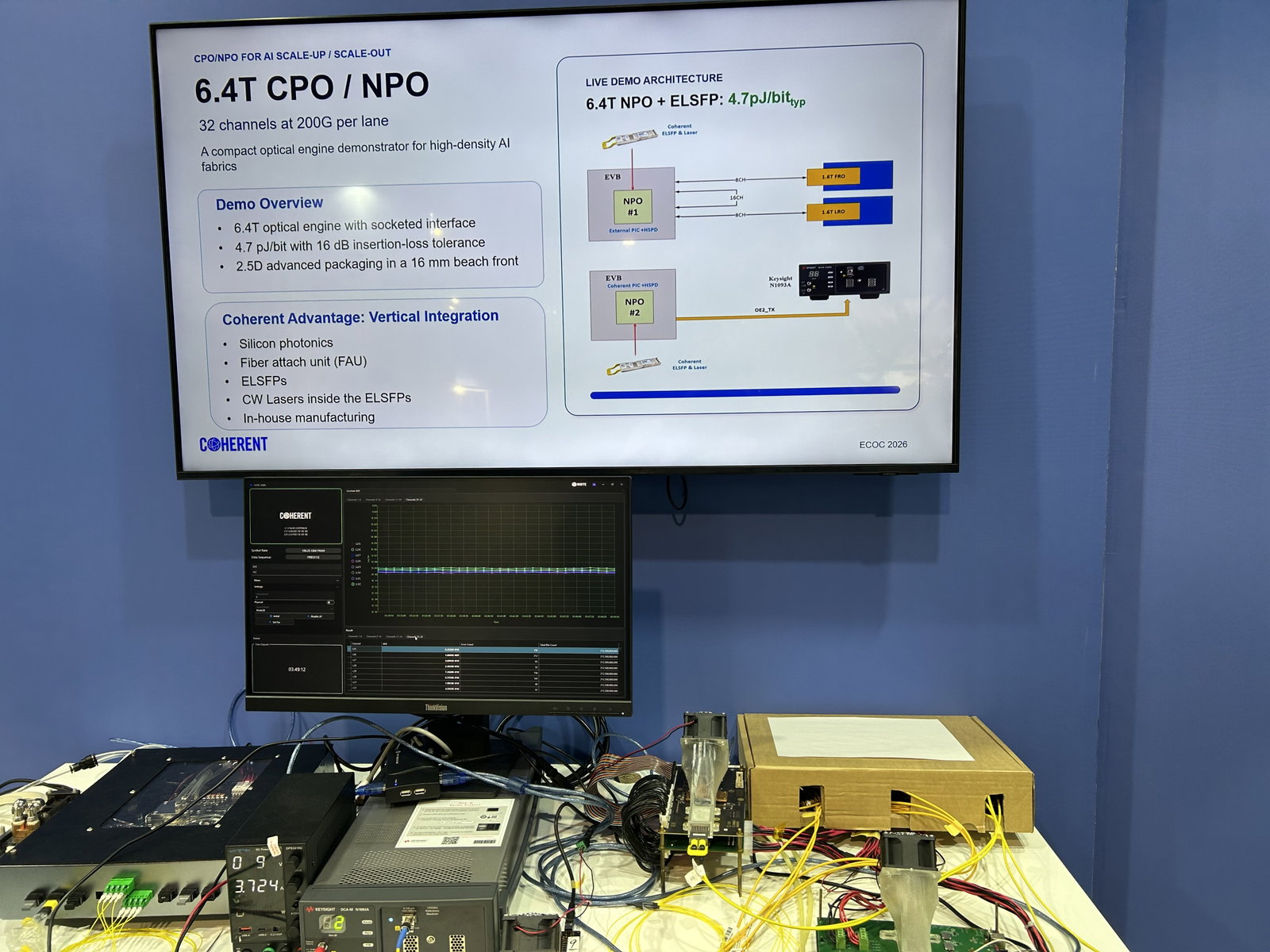
The company sees itself as a one-stop shop for optical connectivity. “We make all the photonic components that go into an optical signal chain,” explains Parthasarathi, “starting with the generation of the photon, the shaping of the optical beam, the guiding of the photon, essentially putting it back into a into a fibre – sometimes a speciality fibre – and then the detection of the photon at the the receiver.
“There's a whole host of components that enable all of this and we are probably the only supplier in the world who has everything in-house – not just the key components, but also the ability to integrate.”
Alongside PhotonLink, Coherent also showed its ‘scale across’ solution, Multirail, which the company first announced a couple of years ago, but is now readily available. “This platform essentially allows you to quadruple transmission capacity between two data centres,” he explains, “while staying within the same volume and power envelope.”
Why vertical integration and scale matter in the AI era
Asked what sets Coherent apart from its competitors, Parthasarathi sets out three key areas: “The first is technology innovation,” he says. “We’ve been a leading pioneer – sometimes even creating new markets – in improving performance and lowering costs across an unrivalled breadth and depth of products. PhotonLink is a great example of this, since it’s an ecosystem-wide solution that only a company of our scope could possibly develop.”
“The second one is deep vertical integration. Our end-to-end capabilities mean our solutions are vertically integrated down to the materials level. That enables us to achieve the highest performance at the systems level you can imagine across materials, subcomponents, components and modules. We can optimise performance at every level.
“The third is our capability to manufacture at scale. The demand for AI at the moment is at a scale the industry has never seen before, and we are responding to that challenge. For example, we would have doubled our production capacity for our indium phosphide by the end of this quarter, with plans to more than double that again over the next 12 months. We are also able to take advantage of geodiversity with our manufacturing capabilities; in today’s increasingly complex world, that becomes an important factor in shoring up supply chains.”