
The growth of artificial intelligence (AI), cloud computing, 5G and other data-intensive applications is placing greater demands on data centres and telecommunications networks. As operators add capacity, they must fit more fibres into the limited space inside racks, cabinets and cable pathways.
Multifibre push-on (MPO) connectors meet this requirement by bringing multiple fibres together within a single connector. One MPO connector can replace multiple single-fibre LC or SC connectors, making high-density installations easier to manage and quicker to connect.
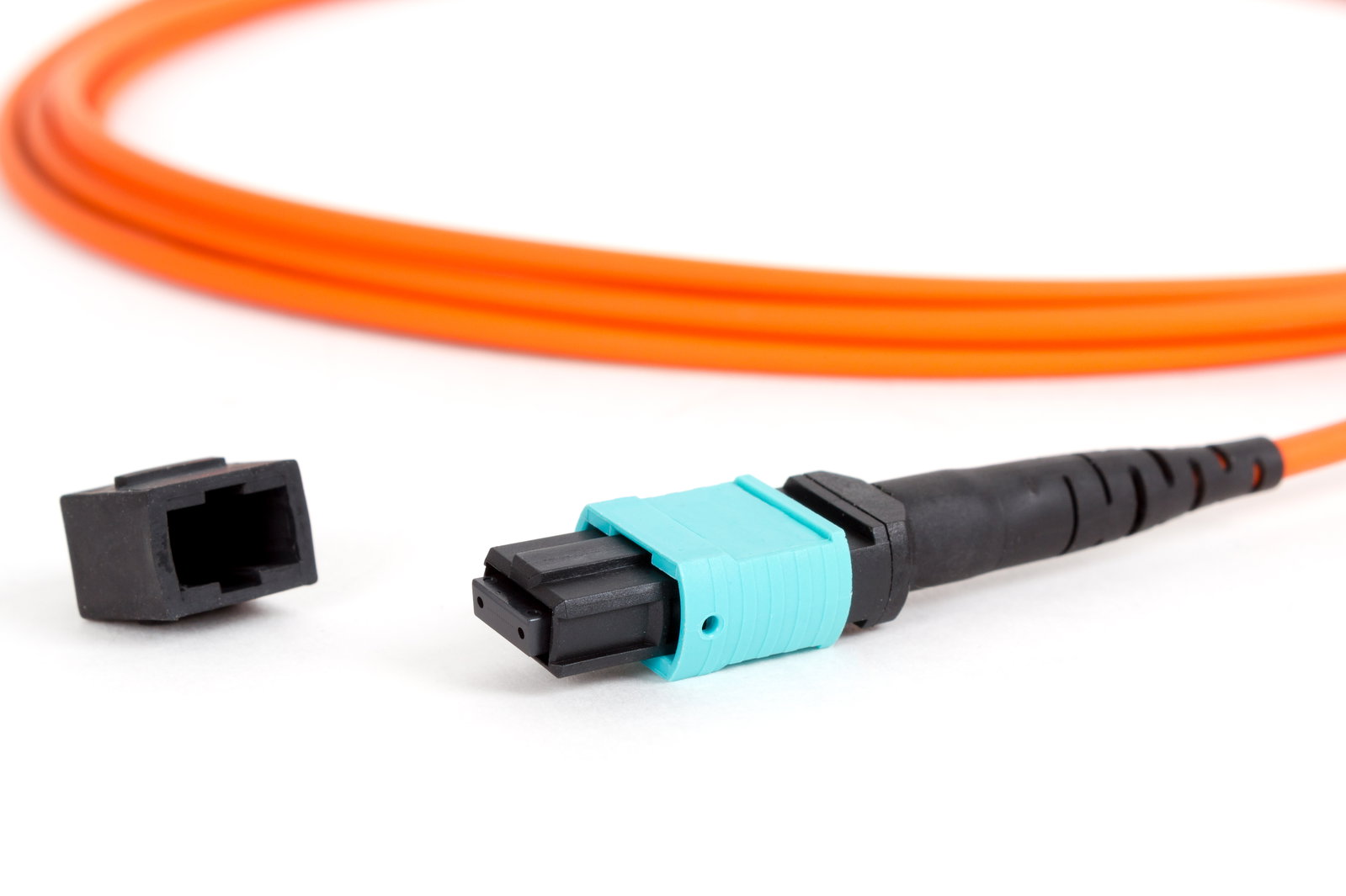
MPO connectors support high-density fibre installations, bringing multiple fibres together in a single connector (Credit: MicroCare)
This density also presents a cleaning challenge. Contamination is one of the most common causes of fibre optic network failure, and its impact is greater when several fibres share one connector. Correct cleaning is essential to protecting performance and ensuring the time saved at installation is not lost later.
Why are MPO connectors different?
An LC or SC connector carries a single optical channel, whereas an MPO connector brings several fibres together within one ferrule, which changes both the likelihood and the consequences of contamination. The larger end face provides more space for dust, moisture, oil and other contaminants to collect. Each fibre also extends a small distance from the ferrule, so the fibre ends touch when two connectors are mated. Anything on one end face is pressed directly onto the other and can affect several channels at once, increasing insertion loss, weakening the signal and, in serious cases, causing network failure.
MPO connectors also come in two configurations: male, with alignment pins, and female, with corresponding guide holes. Both require inspection and cleaning. Contamination collects around the pins and inside the guide holes, where it is harder to reach, and not every cleaning tool is designed for both configurations, so this must be considered when selecting equipment.
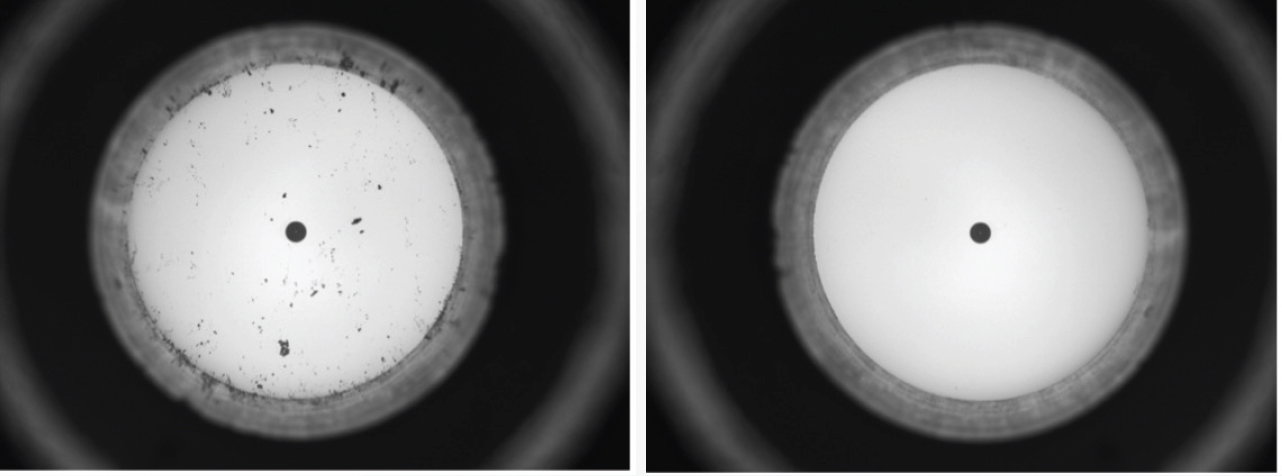
IEC 61300-3-35 provides recognised criteria for evaluating fibre optic connector end faces during inspection (Credit: MicroCare)
The construction of the connector adds further sources of debris. Friction involving the slider, retention clips within adaptors and transceivers, and the guide pins generates microscopic wear particles as connections are made and disconnected. These add to contaminants already on the end face, many invisible without magnification.
Contaminants do not have to sit directly over a fibre core to cause a problem. Those elsewhere on the ferrule can move towards the optical area during handling or reconnection, and vibration may dislodge them after installation, so the whole end face must be inspected and cleaned.
If debris remains when two connectors are mated, the pressure between the end faces grinds it into the ferrule, causing scratches, pits or scarring. Cleaning beforehand removes particles while they can still be dealt with.
Inspect, clean, inspect
Inspection and cleaning should follow a clear sequence: inspect, clean, reinspect, then mate. Both end faces must be included, because contamination left on either surface will transfer to the opposing ferrule and can damage both connectors.
This applies even when a connector is new, capped or was cleaned earlier. Protective caps limit exposure during storage and transportation, but do not guarantee the surface beneath them will be clean when the connection is made.
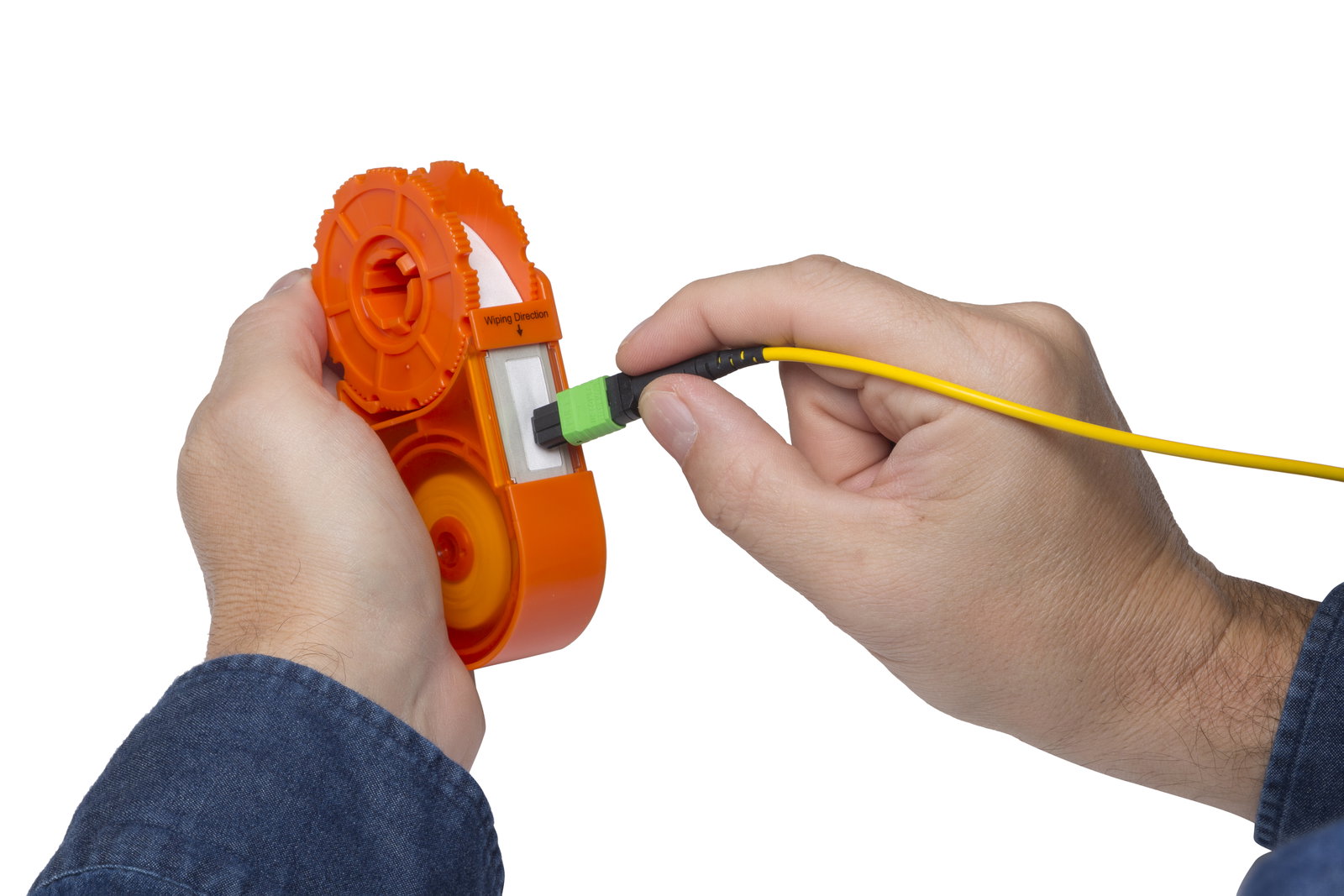
Cassette cleaners use a micro-woven ribbon to capture particles and absorb residues from MPO end faces (Credit: MicroCare)
A fibre inspection scope allows technicians to examine areas that cannot be assessed with the naked eye. However, inspection is not simply a matter of deciding whether an end face looks clean. IEC 61300-3-35, published by the International Electrotechnical Commission, provides recognised pass/fail criteria for different areas of a fibre optic connector end face. Used with the scope, it gives installers a consistent basis for determining whether a connector is ready to be mated or requires further cleaning.
If an end face fails, it should be cleaned using a method suited to the connector and the contaminant present, then re-inspected to confirm the process has worked and particulate has not simply moved to another part of the ferrule.
Choosing a method
Dry wiping can generate an electrostatic charge through friction between the cleaning material and the dielectric MPO ferrule. This charge attracts airborne particles back to the surface, and repeated wiping only increases the build-up. Tools made from static-dissipative materials help limit this effect, but wet-to-dry cleaning removes contaminants while allowing the static to dissipate.
The process uses a controlled amount of optical-grade cleaning fluid followed by a dry section of the cleaning material. The fluid loosens oils, particles and other residues and provides a path for the charge to dissipate; moving immediately to the dry area lifts away the contamination and any remaining fluid.
Only a high-purity, fast-drying fluid developed for fibre optics should be used. A low-surface-tension formulation spreads across the end face without flooding the connector, and hermetically sealed packaging protects it from moisture and airborne contaminants. Only a small amount is needed as too much will spread residue into surrounding areas.
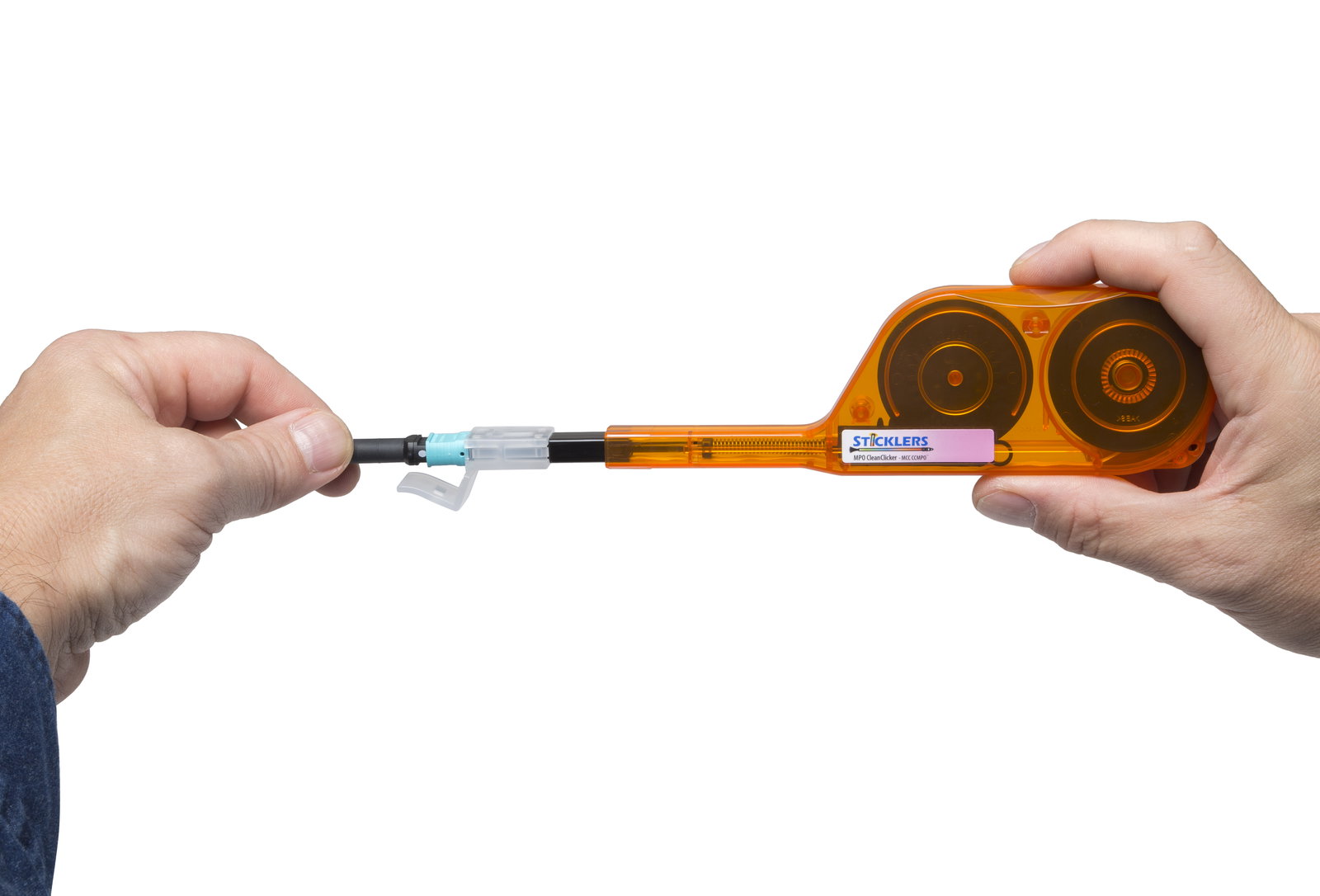
Click-to-clean tools are convenient for routine work (Credit: MicroCare)
Click-to-clean tools are convenient for routine work and are available in designs for both male and female MPO connectors. For wet-to-dry cleaning, the tool tip is touched against an optical-grade wipe dampened with cleaning fluid, then inserted into the connector and activated. Fluid should not be applied directly to the tip, as this may oversaturate the internal material. Each activation advances the ribbon, presenting a fresh section for the next connector.
Cassette cleaners use a micro-woven ribbon to capture particles and absorb residues; some are designed separately for pinned and unpinned connectors, so compatibility should be checked. For wet-to-dry cleaning, a small amount of fluid is applied to one area of the ribbon and the connector is drawn across it in one direction, from the dampened section to the dry. A fresh part of the ribbon should be exposed for each end face, and no cleaning material should be reused once contaminated.
Cleaning at scale
The importance of cleaning increases with the scale of an MPO installation. A single missed contaminant may result in further inspection or fault finding, but small inconsistencies repeated across hundreds or thousands of connections can add considerable time to installation and commissioning.
The issue is not simply whether an individual end face can be cleaned, but whether the same standard can be achieved consistently across every connection. Making inspection and appropriate wet-to-dry cleaning part of the established process helps prevent installation efficiencies from being lost through repeat work, call-backs and avoidable network faults.
As MPO supports an increasing share of high-capacity fibre infrastructure, cleaning practice must keep pace with the demands placed on the technology. Protecting the end face at installation and throughout maintenance is critical to achieving reliable performance over the life of the network.
Liam Taylor is European Business Manager, Fibre Optics at MicroCare UK Ltd and a member of IEC/SC 86B Working Group 4. MicroCare manufactures the Sticklers™ brand of specialist fibre cleaning tools.