
AI is driving unprecedented demand for optical interconnects. But as data centres scale their AI clusters, they're running into a problem that extends beyond just needing more bandwidth. The optical components—lasers, fibres, connectors, photodiodes—need to work together as a system, not as isolated pieces. Get that integration wrong, and you can't deliver the power efficiency, density or reliability that AI infrastructure demands.
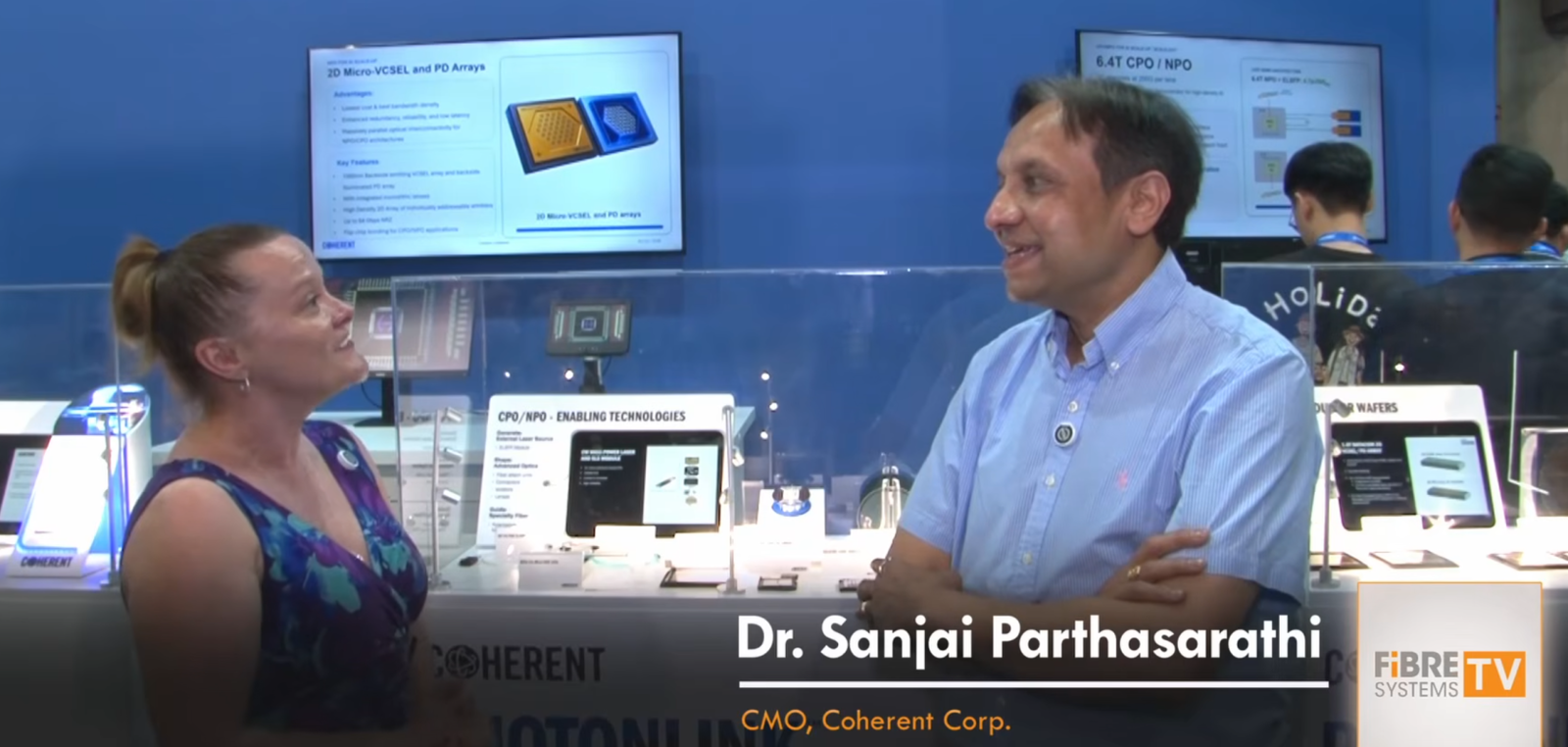
At ECOC 2026, Fibre Systems caught up with Dr Sanjai Parthasarathi, Chief Marketing Officer, Coherent at the company’s booth to explore how it is tackling this challenge with Photon Link, an integrated optics platform purpose-built for AI data centre connectivity.
What is Coherent's complete optical signal chain approach?
Rather than optimising components individually, Coherent is thinking about the entire optical signal path. Photon Link covers generation of light (the photon source), shaping the beam into the fibre, guiding the beam through specialty fibres, and finally receiving the signal on the other end. That integration spans co-packaged optics (CPO), near-packaged optics (NPO), and emerging chip-to-chip interconnects.
"Photon Link is our integrated optics platform that's purpose-built for data centre connectivity for AI data centre connectivity,” said Parthasarathi “It covers the entire optical signal chain starting from generation of the light, then shaping the beam into the fibre, then guiding the beam through specialty fibre, and finally on the other end receiving the signal."
How is Coherent solving density and capacity challenges?
One of the standout demonstrations Coherent showed was its high-density microaxial and photodiode arrays coupled with multi-core fibre. A single fibre can carry 37 independent signals simultaneously, all through one fibre that looks like a standard single-core fibre from the outside. That's a fundamental shift in how much data you can move through the same physical footprint.
The 6.4T CPO and NPO solution on display demonstrates the complete approach: 34 channels running at 200Gbps per lane, live. It's not a prototype or a concept. It's a working solution on the show floor.
Why does optical integration matter for AI?
AI data centres have tight power budgets. Every watt counts when you're running thousands of GPUs. Coherent's integrated approach reduces power consumption by optimising the entire signal chain together, rather than designing components that work in isolation and then hoping they work well together. That's the difference between a solution that barely works and one that actually scales.
Coherent's portfolio includes polarisation-maintaining fibre and multi-core fibre—each solving specific performance challenges. Polarisation-maintaining fibre is critical for coherent optical systems and certain sensing applications. Multi-core fibre multiplies capacity without expanding the cable footprint, which is essential as AI data centres push for higher density.
These aren't general-purpose cables. They're engineered solutions for the specific constraints of modern AI infrastructure: high density, low latency, high reliability.
Watch the full interview