
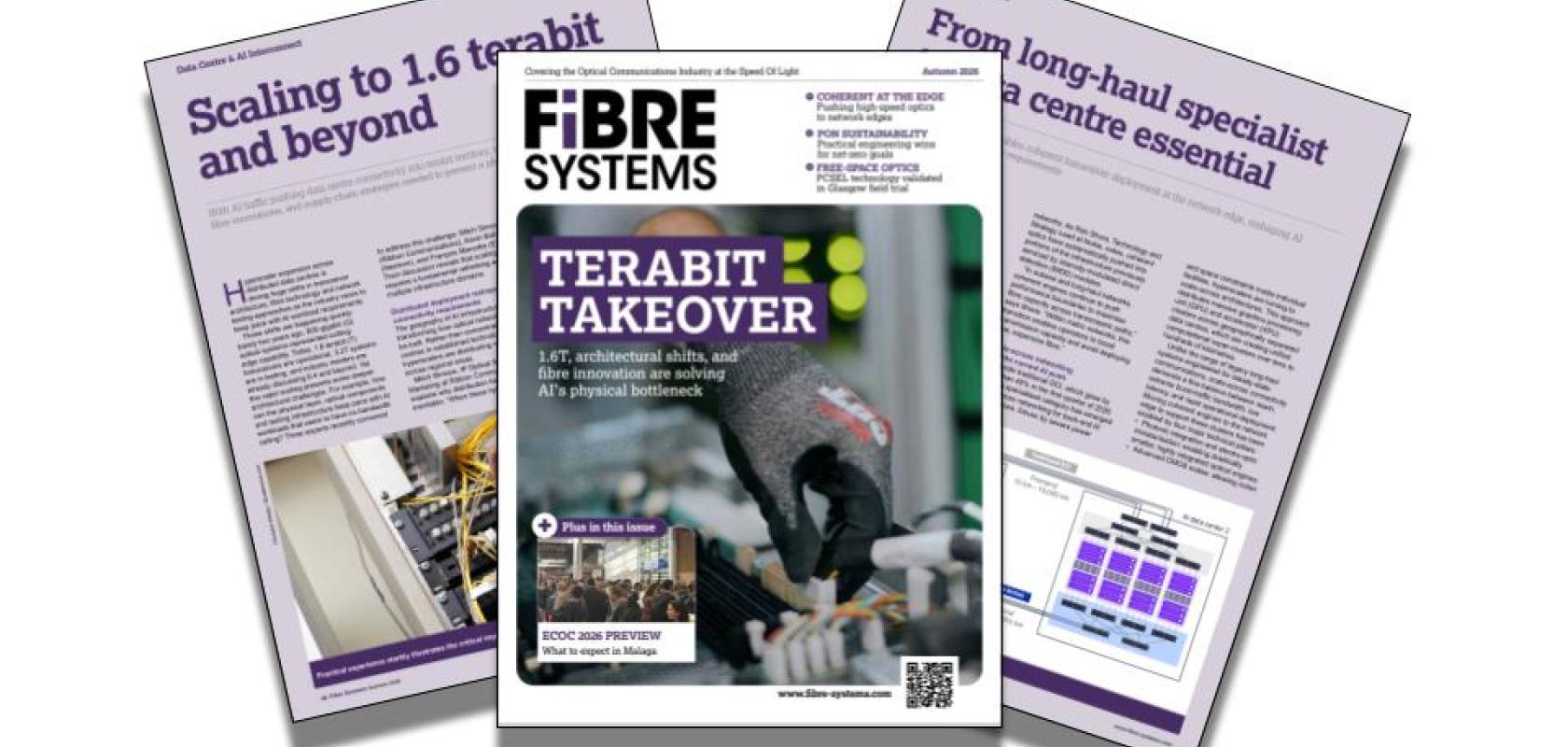
Fibre Systems returns for its second print edition since relaunch. If Spring was the reunion tour, Autumn is where the setlist gets even better. The team that came back swinging in Los Angeles has spent the months since touring the supply chain, the data centre, and the network edge. What it found is that the industry's growing pains have only intensified. AI infrastructure has stopped politely asking for more bandwidth and started demanding it outright. Distributed at ECOC 2026 in Málaga, this issue delivers the critical intelligence and practical solutions network leaders need to meet that demand head-on.
Where Spring was about proving the industry could build fast enough to keep pace with 1.6T adoption, Autumn finds that question already answered. The new one is harder: how do you build infrastructure that does not just scale, but holds together while it does?
The Headliner: Scaling to 1.6 terabit and beyond
No comeback tour survives on nostalgia alone, and this issue's headliner, Scaling to 1.6 terabit and beyond, makes the case that the industry has already moved past the debate stage. Barely two years after 800G was cutting-edge, 1.6T transceivers are operational, 3.2T is in testing, and insiders are quietly discussing 6.4T and what comes after it. The feature asks the harder question: can the physical layer: optical components, fibre itself, and the testing infrastructure behind both; actually keep pace with workloads that seem to have no bandwidth ceiling?

Practical experience starkly illustrates the critical importance of cleanliness at such high speeds (Credit: Chubykin Arkady / Shutterstock.com)
The feature draws on Mitch Simcoe (Ribbon Communications), Kevin Boll (Nextrom), and François Marcotte (EXFO) – three experts converging on the same conclusion from three different directions: distributed AI data centres, multicore fibre, and continuous validation testing are no longer optional extras, they are the only way the maths still works. As one contributor puts it, fibre construction is back, and the old rules no longer apply.
Heading to Málaga
This issue arrives just in time for ECOC 2026, and the preview explains why more than 8,000 professionals and 340 exhibitors are heading to Malaga this September. Europe's optical communications conference has restructured its entire technical programme around one uncomfortable realisation: optical technology, not compute capacity, is what is actually constraining AI infrastructure scaling.
Expect hollow-core fibre moving from research curiosity toward a commercial deployment pathway, sessions interrogating whether pluggables or co-packaged optics win the scale-up argument, and a growing quantum communications track edging closer to field trials. ECOC has always been where the industry compares where it is against where it thought it would be by now. This year, with power consumption emerging as the real ceiling on network expansion, not fibre availability, that comparison looks set to be a pointed one.

From the network edge to the rooftop
Coherent optics gets its own reckoning too. From long-haul specialist to data centre essential traces how a technology built for thousands of kilometres of subsea and long-haul fibre has spent the past 15 years working its way inward – first into metro, now into campus-scale AI interconnect. Nokia's Rob Shore and Ciena's Helen Xenos make the same point from opposite ends of the industry: coherent is no longer a single architecture, it is a toolkit, with "coherent lite" now doing for short-reach links what full-spectrum coherent once reserved for oceans.
Elsewhere, sustainability gets a refreshingly unglamorous treatment. Sustainability in network infrastructure starts with smaller decisions, by Amphenol's Ed Solis, argues that net-zero targets matter less than whether a connector is installed properly the first time. For anyone who still thinks optical communications means fibre in the ground, PCSEL technology debuts in real-world FSOC trial reports on Vector Photonics and Fraunhofer CAP beaming data across the River Clyde in Glasgow: proof that free-space optics is inching out of the lab and onto the waterfront.
Beyond the dumb pipe
The issue's news round-up, Securing the infrastructure, is where the Autumn theme really crystallises. Nvidia and Corning's manufacturing partnership, Molex and Prysmian's €5.5bn cabling agreement, new regulatory oversight of submarine cable landing stations, and a Northwestern University demonstration of quantum entanglement riding alongside live commercial traffic on the same fibre: taken together, they tell a story less about speed than about who controls the infrastructure underneath it.
That same instinct, build resilience, not just capacity, runs through the issue's operator-facing features too. Intelligent network operations: a new playbook for telcos makes the case for unified network intelligence and GIS as the tools that let operators actually see what they have built, while How network operators can monetise data to boost ARPU tackles the industry's other uncomfortable truth: operators built the highways, but hyperscalers keep collecting the tolls.
Neither piece pretends the answers are easy. Both make a solid case that the industry is finally asking the right questions.
Two events, one shared theme
This issue also carries Fibre Systems' first proper look at Connected Britain 2026, returning to ExCeL London on 9–10 September. Unsurprisingly, data centre infrastructure appears as a dedicated conference track for the first time, alongside the UK's now-familiar preoccupations: the rural digital divide, the copper switch-off, and a skills shortage showing no sign of easing. It is a reminder that the terabit takeover is not only a hyperscaler story, it is reshaping national infrastructure planning too.
Back on the show floor
The Fibre Systems team will be at ECOC 2026 in Málaga throughout the show. If you have insights to share, developments to discuss, or simply want to say hello to a media brand that is clearly not slowing down, they would love to hear from you.
Two issues in, and the momentum is only building. See you in Málaga.
All features from the Autumn 2026 issue are available online at www.fibre-systems.com. Register to receive the magazine now.