A research team at the Pohang University of Science and Technology (POSTECH) has unveiled a physical encryption platform that could potentially change the security architecture of optical communications.
By shifting the "key" from digital code to the physical properties of light and device geometry, the technology offers a robust defense for fibre-optic and free-space optical (FSO) links against increasingly sophisticated interception techniques.
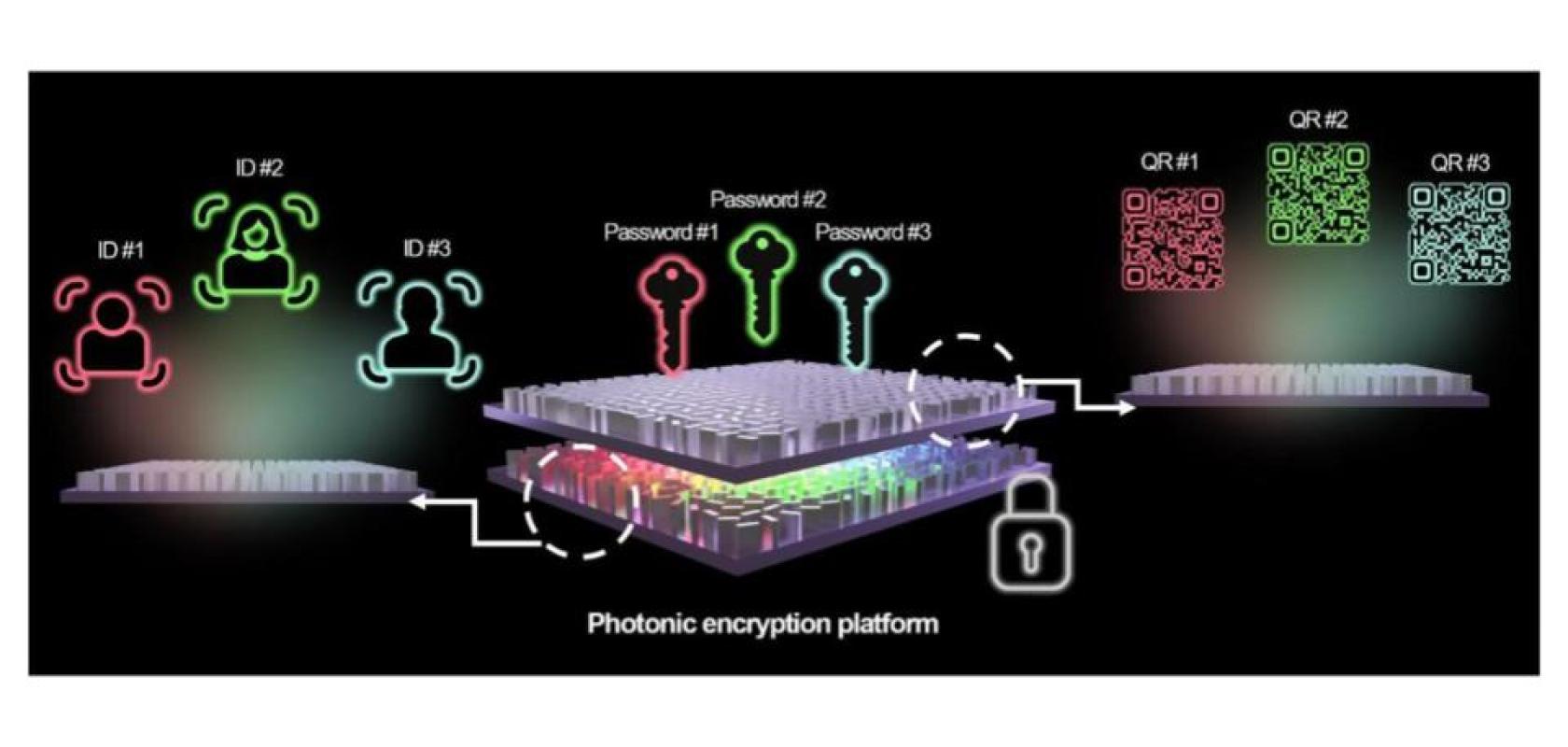
Detailed in Advanced Functional Materials, the study led by Professor Junsuk Rho uses stacked metasurfaces to create an "optical password." Unlike traditional software-based encryption, which is theoretically vulnerable to being "brute-forced" or decoded by quantum computers, this approach ensures that data is only legible when the physical parameters of the transmission, specifically wavelength and interlayer spacing, align perfectly.
Beyond digital code: A physical password
The system replaces electronic encryption with an all-optical architecture. At its core are metasurfaces. These are engineered materials only a fraction of the thickness of a human hair, covered in nanostructures that manipulate incident light.
Information remains concealed until two specific conditions are met simultaneously:
The correct wavelength: The system must be hit with a designated colour of light (e.g., a precise shade of red or blue).
The correct spacing: The metasurface layers must be separated by a precise, microscopic distance.
If either the wavelength or the distance is off by even a tiny fraction, the data remains a blur. When they align perfectly, the "physical password" unlocks, and the hidden data, such as a secure QR code or identity hologram, is revealed through diffraction and interference patterns.
Potential for the optical communications supply chain
For the optical communications industry, this technology suggests a future where high-value data links are protected by hardware keys that cannot be copied or shared digitally. Because the encryption is tied to the physical configuration of the transceiver, it provides a powerful "physical layer" defence.
Key industry applications include:
Secure fibre-to-the-X: Creating point-to-point hardware keys that prevent unauthorised users from decoding intercepted light signals even if they "tap" the line.
Next-gen FSO and satellite: Ensuring that sensitive satellite-to-ground communications are only readable by receivers with the exact physical metasurface configuration.
Optical anti-counterfeiting: Developing unforgeable security labels for high-end optical components and networking hardware.
"By using the physical properties of light itself as a security key, this study could fundamentally reshape the paradigm of traditional digital security," says Professor Rho.
The researchers note that the number of possible information channels grows rapidly as the design scales, making it a compelling prospect for the next generation of secure, high-capacity optical infrastructure.
Citation
C. Park, Y. Jeon, S. Lee, Y. Kim, and J. Rho, “ Recomposable Layered Metasurfaces for Wavelength-Multiplexed Optical Encryption via Modular Diffractive Deep Neural Networks.” Adv. Funct. Mater. (2025): e23309. https://doi.org/10.1002/adfm.202523309