
South Korean opto-semiconductor specialist Seoul Viosys is making a strategic movement into the AI data centre optical communications market. The company has announced joint development discussions with two global optical interconnect companies and is positioning itself as a total transceiver solution provider rather than a component supplier.
The company, which is listed on KOSDAQ and holds the world leading market share in UV LED technology, is leveraging its VCSEL technology and proprietary WICOP packaging architecture to address growing demand for high-speed, low-power optical interconnects inside AI data centres. Seoul Viosys acquired a VCSEL company for short-range communications five years ago and has since completed development of 100G (25Gbps x 4) class technology.
From components to total solutions
The strategic pivot is significant. Rather than supplying discrete devices into the transceiver supply chain, Seoul Viosys is seeking to establish itself across design, devices, drivers, and modules. This full-stack position would place it in direct competition with established transceiver vendors as well as component suppliers.
Joint venture and OEM manufacturing discussions are under way with two undisclosed global data interconnect companies. The company is also exploring expanded collaboration with partners in the United States and Japan, as well as new manufacturing partnerships in India. Its existing production infrastructure spans the US, Vietnam, and South Korea.
The patent position
Interestingly, Seoul Viosys' most distinctive competitive asset may be its intellectual property rather than its manufacturing scale. The company holds approximately 1,800 patents specifically related to micro opto-semiconductor optical communications. These are built around its WICOP technology, which is a wire-free, package-free structure designed to maximise light extraction efficiency and thermal performance at scales down to one micrometre.
That portfolio was put to the test in February 2026, when its US subsidiary SETi secured a permanent injunction from a US court against a photonics company with a four-decade history in optoelectronics. The case signals that Seoul Viosys is prepared to enforce its IP position aggressively as the optical interconnect market intensifies. The company's broader opto-semiconductor patent portfolio totals approximately 21,000 patents across packaging and solutions.
Technology underpinning
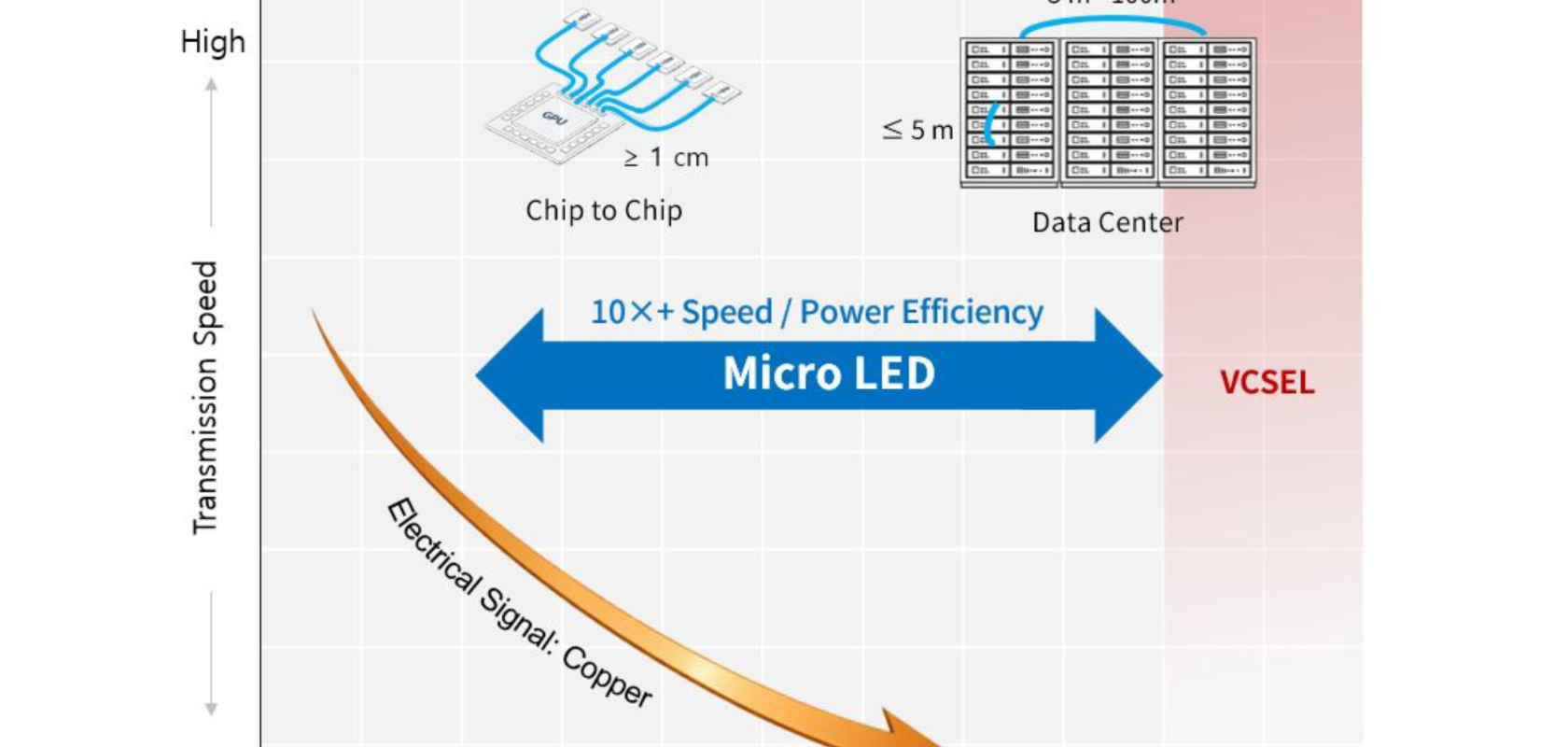
Seoul Viosys has collaborated with a research team at the University of California, Santa Barbara, led by Nobel Prize laureate Shuji Nakamura, for more than 20 years. This partnership produced an ultra-small 1µm-class device in 2021. The company argues that micro LED-based photonic technology is well suited to AI data centre environments where conventional copper interconnects are reaching their physical limits in supporting ultra-high-capacity, high-speed transmission.
Dr Dae-Woong Suh, president and head of R&D at Seoul Viosys, said the company is open to working with partners who need its technology, adding that under strict confidentiality it intends to introduce products with them.
Market context
According to Grand View Research, the global short-reach optical interconnect market is forecast to grow at a compound annual rate of around 20% through 2030, reaching approximately $6 billion. Seoul Viosys has framed its total addressable market more broadly at $60 billion, encompassing the wider AI data centre optical communications opportunity.